Cleopatra, Vaz, Massias
It began with a name.
In 1829, a Jamaican woman called Elizabeth Thomas Massias wrote her son into the world with all the power she had—a surname.
She had no legal patronage, no husband, no inheritance, and no voice in the colonial record beyond the tight cursive handwriting that marked her as “unmarried.”
But she took the name Massias anyway, claiming it from a man who never signed his name to her fatherhood, weaving into her son’s future—the only thread of protection she could offer him.
This name, and the quiet naming of his father, gave her son a legacy that could open doors, that could make more of him than she could ever provide.
She gave him lineage in a world built to deny hers.
A century later, across the Atlantic in Liverpool, another woman—my Nana—made the opposite choice.
She omitted the name of her child’s father, keeping it a secret through war, marriage, and motherhood.
My mother’s lineage—half-hidden—was buried with my Nana’s silence.
Not because my mother didn’t matter to her, but because she did.
And in a world of shame and racism, silence and the olive skin of her daughter were the only armour she had.
From the woman who lived in my inbox for twenty years to the dreams that led my search, this is the story of what’s been lost and found between those two decisions.
It’s about the women who protected their children.
It’s about the names we carry, the ones we bury, and the ones that claw their way back into the light through threads we’ll never understand.
This is our story.
Jamaica, 1829.
At the registry office in St Catherine, a woman gives the clerk her name—all of it: Elizabeth Thomas Massias.
That extra surname, Massias, doesn’t appear by accident. It’s a signpost slipped into history, pointing to a lineage she carried but would never be officially recognised for.
Elizabeth was most likely born a free brown woman, thanks to a father who wouldn’t claim her, but whose social standing provided just enough protection to keep her outside the grip of slavery.
Standing within a system designed to deny women like her any real power, she makes her move.
When it comes time to name her son, she doesn’t settle. She adds another significant name to the record—his father’s: Vaz.
In that moment, Elizabeth does what the system won’t. She connects the boy to both men.
This isn’t just a registration. It’s an act of security.
I suspect both men were of high standing.
That was often the currency that gave them unchecked access to the bodies of young Black and brown women.
Elizabeth—like her mother before her—would have worked in close proximity to such men, perhaps as a housemaid, needleworker, or washerwoman.
Her mother, unnamed in any record, most likely lived as a slave.
Elizabeth and Horatio are the first figures to emerge from the fog of my maternal ancestry, names pulled from scanned pages and fading ink.
It took me nearly half a century to find them.
Nearly one hundred years after Elizabeth registered her child’s birth, my sister received a DNA kit as a Christmas gift.
She’s always been drawn to our family’s origins—it was once a weekend ritual with our father, hours spent squinting at microfilm in the city library.
But that was a lifetime ago. The trail had gone cold. Life, as it does, had taken over.
She swabbed her cheek and sent off the little box—filled with possibility—to the lab. Then she waited.
Weeks later, my phone lit up with a single, cryptic message: “You’re not going to believe this.”
Attached was a screenshot: a colourful ancestry wheel crowded with percentages and country names.
What am I looking at? I texted back, impatient.
“It’s my DNA. Look—it says I’m mixed race. It’s on Mum’s side. Mum is mixed race!”
I was puzzled for a moment, but then the old cogs began to turn.
We’d always laughed at photos of Mum as a child. Everyone laughs at old family photos, right?
But we’d fixated on one particular feature: her hair.
As a child, she had the most stunning corkscrew curls. Yet by the time her younger siblings came along, the curls were gone—cut away, replaced by what we could only describe clumsily as a “white afro.”
The contrast was stark, especially next to her siblings’ neat, poker-straight bowl cuts, their faces distinctly like their fathers’: Mum’s not.
Those two photos are still hanging on the sitting-room wall.
The truth in plain sight.
“Does Mum know?” was the first thing I asked.
Turns out, she did.
She casually shared how the man she came to call Dad had bought her a bicycle as a child and how she’d never asked her mother about her paternity in case it hurt her mother’s feelings.
Somehow, I suspect she expected no enlightened response.
It wasn’t customary to dwell on the past.
My nan had been married previously; my mother was a product of that short union.
Had he died, or had they divorced?
My mind went wild.
Who was this guy?
And why were we never told about him?
The search for my missing grandfather and Nan’s first husband began.
I obtained a copy of Mum’s birth certificate.
The name was the same as her mother’s maiden name: Foster.
I traced him through records, found people, and reached out; all the while our African and Portuguese heritage remained a mystery.
My sister took to chasing her DNA strands around the USA, the literal fragments of her identity scattered across the earth.
Me? I decided to have my own DNA tested.
Maybe my sister’s had been mixed in the lab.
Maybe she wasn’t my sister.
Maybe we’d find out more about who we were.
I decided to use a different company this time, again popping my DNA in the postbox to be filed, matched—and possibly used for nefarious gains in the future.
I didn’t care. I just wanted to see if my sister was the family oddball.
She’d always said she was convinced she’d been adopted; now this was her chance to break free of us.
Unfortunately for her, the results confirmed not so.
While my sister’s test had got the ball rolling, mine provided a lead.
“Oh my God! We’ve got an Auntie and cousins in Liverpool!”
By now, my younger brother, had started to lean in on the action.
Where my sister and I were driven by the story, my brother was driven by his face.
Whose face did his echo?
Because, truth be told, my brother looked more like Mum than we ever did, and he certainly shared no features with any of our cousins either.
So it was him who took the lead in reaching out to our potential long-lost aunt.
I can’t really describe how it feels to intrude into someone’s life who you should’ve known all along.
The message was awkward, meek, and unsure.
Though when my brother hit send, this total stranger came back and confirmed our connection like she’d been waiting for it—and, to some degree, was expecting more.
We didn’t know what to expect.
But what we found was more than we hoped.
She was warm, welcoming, and generous with her knowledge.
Her father’s name was Aston Vaz.
The same name my Nan had taken to her grave—our grandfather.
As my aunt explained, she’d always known about my Mum but had been told Mum had emigrated to Australia.
And there wasn’t just her either.
In conversations with her, we learned of a whole family of aunts and uncles in Liverpool and around the world.
It was apparent—and sad—that these relatives had known about each other, and yet we’d been kept in the shadows of their lives.
Secrets made of our blood.
But this was to be expected.
Nan had been married for just four months at the time of my mother’s conception and had likely just sent her husband off to war, possibly a man she’d never see again.
My Grandad, on the other hand, had made his passage from Jamaica to the UK on a banana boat bringing supplies to the country, and Nan had fallen for his charms—or perhaps he’d fallen for hers?
We’ll never know.
I won’t pretend to understand what war does to people.
But when every moment might be your last, who can blame anyone for grabbing hold of something that makes them feel alive?
Unfortunately for my Nan, her chance of living in the moment would be etched into her life forever—through the very existence of my Mum.
When my brother asked her if she had a photo of Aston, she said yes—and he was elated.
Finally, a chance to trace his unfamiliar features back to their source.
My aunt’s email explained: you could always spot a ‘Vaz’ by their distinctive features.
And when he opened the attachment, he too knew what she meant.
He was looking into a mirror—the eyes, the nose, the chin. Distinctive family traits.
He showed us the picture.
We gasped.
I wondered how Nan had felt, watching my brother grow up with a face that mirrored the man she never named.
I wondered if it made her feel discomfort, fondness, shame, or regret—perhaps all.
Meanwhile, my aunt was excited at the prospect of being reunited with her sister—especially now, as the sisters she knew had started to pass away.
She eagerly asked him to pass on her message:
she would really like to connect.
But when we broke the latest news to Mum, she grew cold.
Distant. Sharp.
“He is nothing to me.
That is not my family.
My father is the man I called Dad, and my family are those I know.”
She made it explicitly clear: she wanted nothing to do with these people.
She shut the conversation down completely.
There was no interest in seeing her biological father’s face, no curiosity left to explore.
The cupboard of skeletons, slammed shut.
“He was nothing but a sperm donor.”
Her pain seared through me and my siblings.
We couldn’t understand its origins exactly, but pressing further felt like trespassing.
We didn’t know if she had ever suspected her racial background—or if she had always known, and simply chosen not to face it.
Whatever the truth, it was too painful, too uncomfortable, and, at over seventy, something she was unwilling to confront.
So, just as she had foregone her own curiosity about her mother,
we felt we had to do the same.
To be silent once more.
We left the conversation alone—for a while.
Then one day, my sister raised it again.
“Someone I once worked with asked me if I was a Vaz,”
Mum said.
But when my sister followed up, she was shut down again.
Quickly. Firmly. End of conversation.
By now, my brother’s curiosity had been satisfied.
He knew who he was.
He knew where his face had come from.
Mine, however, remained unanswered.
Grandad Aston was Jamaican—and I knew, somewhere down that line,
it would lead to slavery.
I felt apprehensive.
But I couldn’t not try to understand.
So I started my search.
That’s when I found her: Aston’s mother.
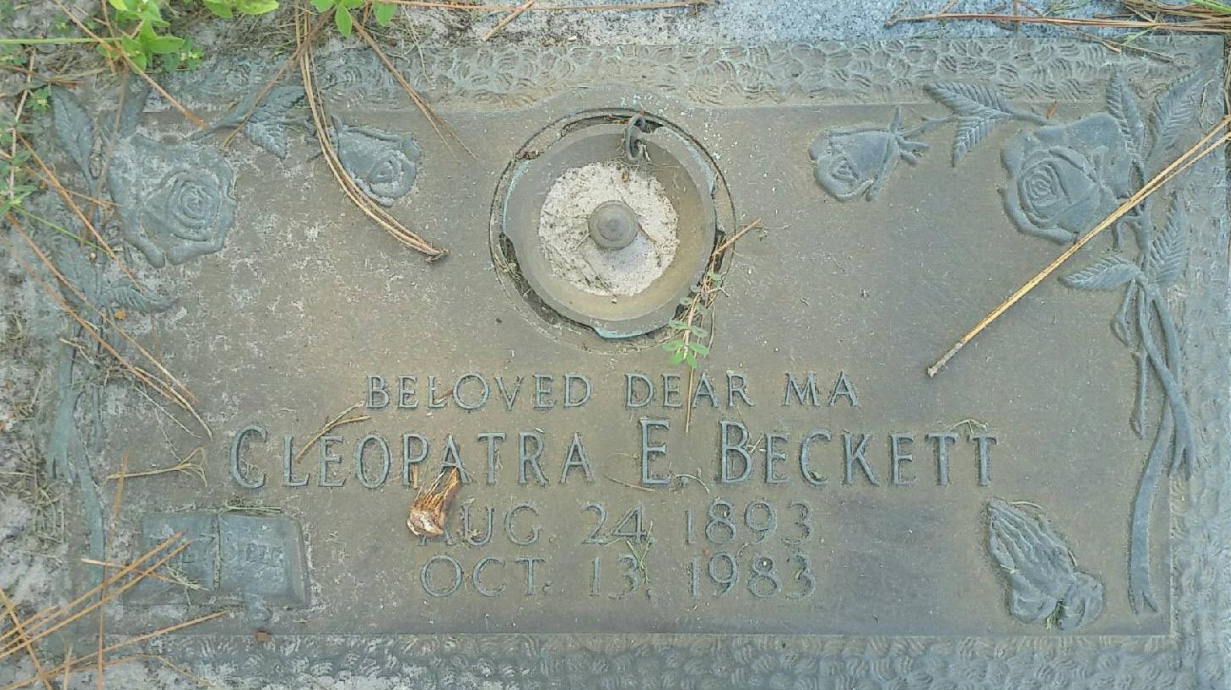
Her name stopped me cold—Cleopatra Elisabeth Beckett.
Cleopatra had been the name of my first cat—and, by extension, my first email address: cleo21.
A coincidence? Maybe.
But it felt like something more.
A whisper from the past.
A presence brushing against my life before I ever knew who she was.
As a child, I was fascinated by the Egyptian queen—not just for her beauty, but for her power.
It felt rare to see a woman admired for how she looked and still remembered for how she ruled.
Even then, I understood that kind of power—subtle, strategic, often silent—was sometimes all a woman had.
And sometimes, it was all she needed.
My great-grandmother’s name was no mistake.
Her mother, Emma, hadn’t just given her the name of one great queen—but two.
A gesture of hope.
A kind of elevation from her own humble working-class life.
What mother doesn’t wish the best for her child?
But in the late 1800s, ambition had its ceiling—especially for a young Black woman.
Names could only take you so far.
When I uncovered Cleopatra Beckett’s early life, I recoiled.
She had ten children over her ninety years.
The first, a daughter named Myrtle, was born when Cleopatra was just sixteen.
The father, Charles Alfred Vaz, was forty-eight: a doctor, well-established.
Already a father of twelve with another woman.
And now, apparently, beginning a new lineage with my great-grandmother.
By the time Cleopatra boarded a ship to New York—a year before Charles’s death—she had borne him five children.
I kept wondering:
Did she see Charles as a path to stability?
Was she coerced? Exploited? Loved?
Did she choose this life—or simply survive it?
The truth is likely twisted in all these directions—
a knot of powerlessness, resistance, and the kind of quiet calculation
only a young Black girl with almost no options could be forced to make.
Even that journey to New York was not straightforward.
She was detained at Ellis Island for two days.
The official reason?
She was labelled “immoral.”
Immoral…
I read that word in the scripted log—it landed hard.
It wasn’t the forty-eight-year-old man who, by modern standards, had groomed a child who was immoral.
Nor the colonies, which had failed to raise the age of consent to sixteen, as the UK had done back in 1885.
No.
The burden of society’s moral standards fell squarely
onto the lap of a thirty-year-old woman travelling abroad to see her sister.
For two days, she was detained.
Was she scared?
Was she tired of the double standards—
or did she take it all in her stride,
without even a side-eye?
I tried to trace Cleo’s ancestry, but hit a dead end.
Births weren’t officially recorded before 1878,
and records were sparse for Black or mixed-race families—
especially those born out of wedlock.
And truthfully, I had no desire to trace the man who’d fathered her.
I slammed my laptop shut.
I didn’t have the stomach for more.
Years passed before I picked up the trail again.
I found myself thinking about Cleopatra again.
First, I dreamed of her—felt her presence, acknowledged it.
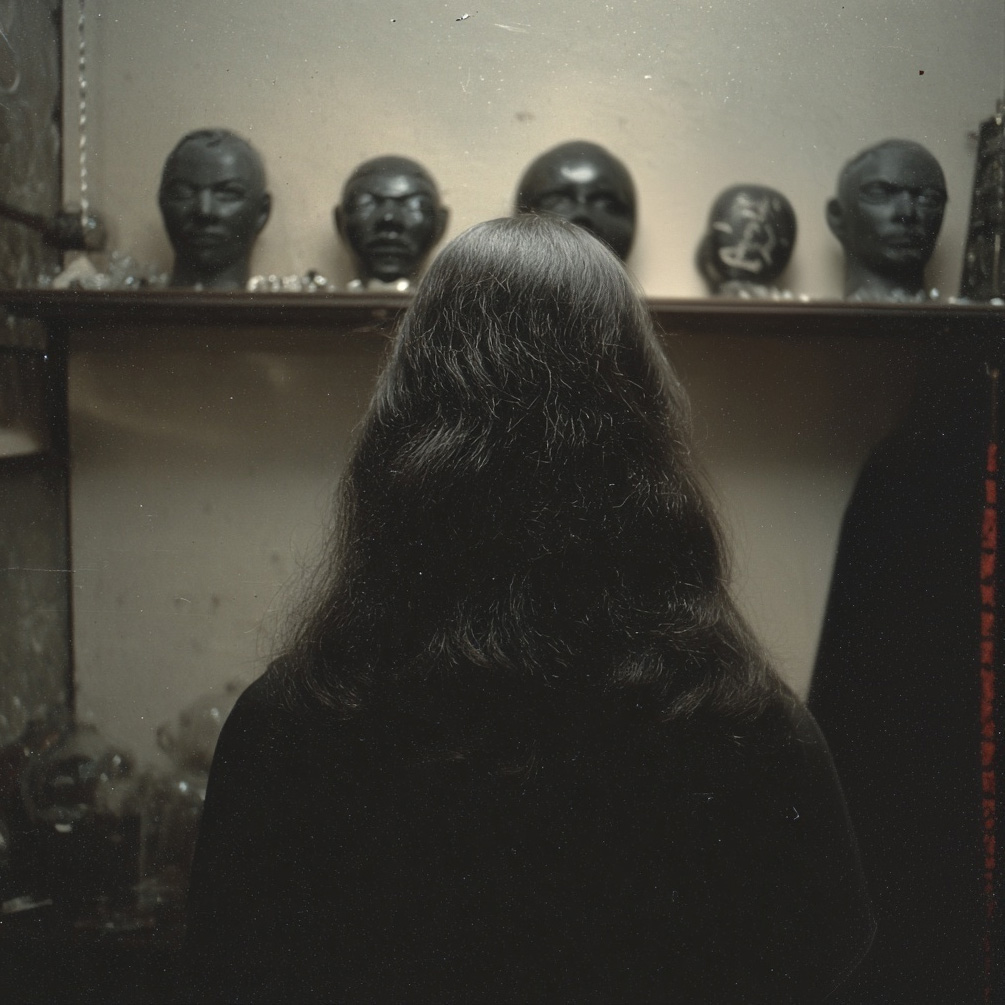
Then came another dream: four ebony heads sitting on a shelf, their eyes closed.
When I woke, I knew—
I wasn’t done.
There was more to know.
More to understand.
Like fog beginning to lift, the facts started coming quickly.
I found Cleopatra referenced in a book.
The author detailed her Ellis Island questioning:
“…unmarried, is supported by a colored [sic] doctor by whom she has four children, the oldest of which is 13 years old.”
I froze.
Colored?
I had assumed Charles Vaz would be white, given his Portuguese heritage.
But now, I wasn’t sure.
I leaned in.
I contacted the author.
To my shock, she responded immediately—kindly, generously.
Cleopatra had been travelling for a medical operation, and yes, the record was correct:
Charles was ‘coloured.’
I searched more.
His partner had been alive in Panama the entire time he was with Cleopatra in Jamaica.
Did these women know about each other?
A year after Cleopatra travelled to New York, Charles married that partner—
just months before his death.
One woman was invited to secure her name.
The other was left behind.
How did Cleopatra feel?
Did he arrange support for her and their children?
The youngest—my grandfather—was just nine.
Or were they all left behind, written out of his ending?
Did the children ever get to say goodbye?
A knot of emotion rose in me—
questions tangled with sadness.
This didn’t feel like a happy ending.
By now, I’d decided to trace this man who had fathered seventeen children in sixty-three years.
How could he afford it?
As a ‘coloured’ doctor, Charles had done remarkably well—
he’d earned medals from the UK Navy for his service.
His father, Horatio, had lived a more modest life—
only two children with a wife of Scottish descent.
But he’d passed down a name and the legal standing that gave Charles his head start.
Like many, I turned to OpenAI and asked if Horatio’s job as a clerk
was common for children of the formerly enslaved.
Slavery ended in 1834.
Horatio would’ve been five.
The model’s response left my jaw slack.
Horatio’s life wasn’t typical—it was exceptional.
He wasn’t just any clerk;
he’d been the crier of the Supreme Court and the Kingston circuit court.
I’d assumed Charles embodied white privilege.
But now, I was watching how Black and brown Jamaicans navigated—
sometimes even flourished—within colonial power structures.
Horatio had stepped into the middle class.
As a respected member of the Masonic lodge,
he was entrusted with caring for a young Black orphan, Augustus Williams.
I even found a letter Horatio wrote to Barnardo’s in London,
vouching for the boy’s character.
And Horatio’s mother?
When I finally found her, I found another woman, silenced and left behind.
Another mother desperate to give her child what she never had.
Elizabeth Thomas Massias—a ghost in the records—
had gifted her son a double-barrelled name stitched with whispers:
Massias. Vaz.
The names Massias and Vaz are deeply rooted in the Sephardic Jewish community
that arrived in Jamaica from Portugal during the Inquisition.
They had, by then, intertwined with the local Black population
through generations of marriages and births.
Though there are no official records of confirmation,
the names in the area around that time suggest Massias was a proprietor
and the Vaz family was respected within the Masonic community.
This wasn’t the machinery of dominant white colonialism.
This was how the marginalised navigated, subverted, and reshaped cultural practices
to carve out space where none was offered.
In another quiet rejection of his paternity,
George Horatio Vaz wasn’t registered in the synagogue—as his name might suggest—
but in the church.
Another inch towards plausible deniability.
Another sidestep around a father’s name.
These Sephardic Jewish names weren’t outside the system.
They were part of it.
Elizabeth’s father had standing, just enough to grant her some protection.
But she was still insignificant.
Just like Cleopatra, born to a Jamaican labourer.
Just like my Nana—diminished by the systems that gave men power and handed women responsibility.
The stories of these women—
and the children they fiercely protected—
show us something else too:
Race, class, and patriarchy are a soup none of us escape.