Tag: boundaries

Moments that centre on energetic, emotional, or relational limits — including saying no, walking away, or withholding presence.

  • Prolapse

    Prolapse

    The Dream

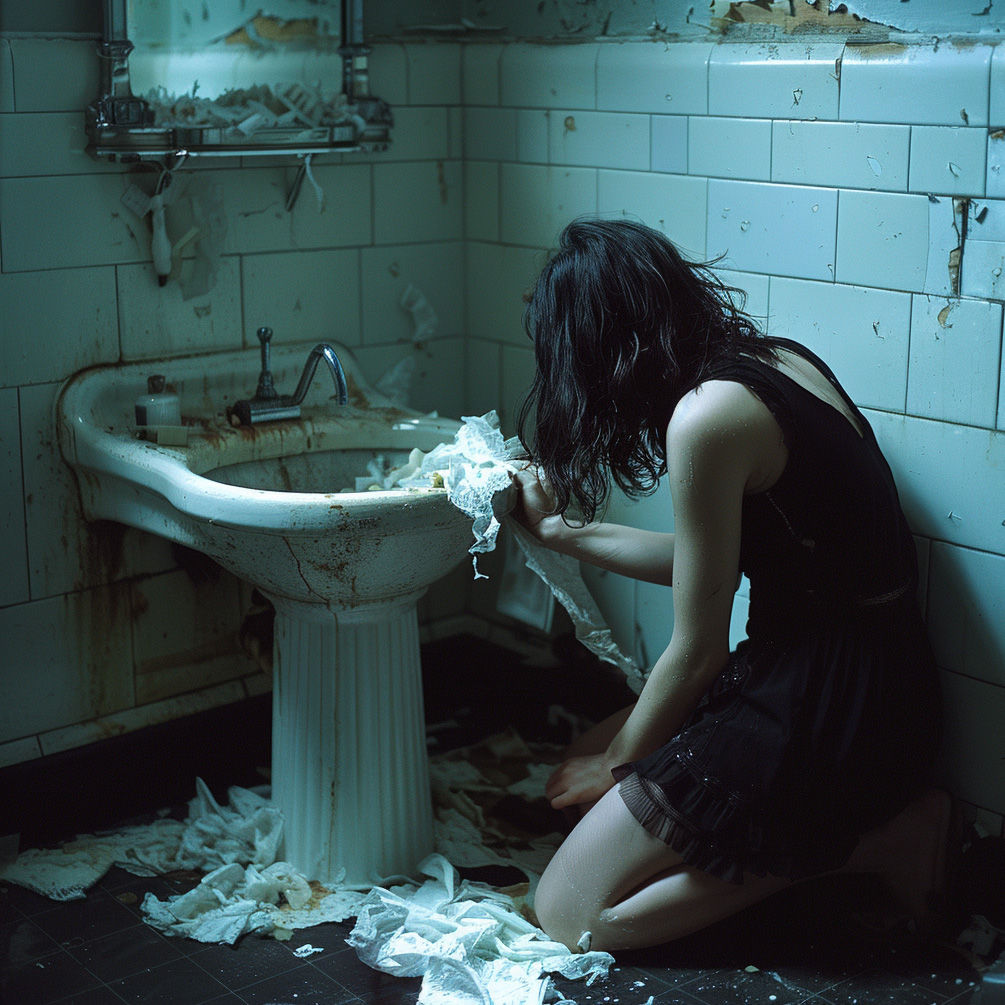
    The bathroom isn’t mine.
    “In a sec,” I sound.

    The toilet—blocked.
    The sink—blocked.
    Paper, everywhere—
    a sodden mess.

    My rectum,
    prolapsed.
    Around me,
    filthy.

    I dig in.

    Deep into the bowl,
    I pull out the mess
    and drop it
    into
    the bin.

    The Meaning

    Before I can even start dealing with my own internal exposures, I have to unblock the system with the mess everyone else has left behind.
    I don’t know who the mess belongs to.
    Yet it’s mine to deal with.

    Because if I don’t, nothing else can flow.

    This is an emotional and somatic backlog.

    What Lingers…

    What if healing starts with clearing what was never owned but still clogs the system?

    What if the flow doesn’t return until the filth is faced?


    Marginalia

    In waking life, I was waiting for test results, which would later confirm a prolapse of my small intestine.

    At the same time, I’d just uploaded my natal chart to AI out of curiosity, while researching ancestry inspired by Cleopatra | Dream of the Name Unspoken and The House That Contains Everything.

    Compelled to write everything down, I wondered if my chart might explain these side quests—pulling me from my herbal medicine studies.

    What I discovered initiated this dream and led me to write the story What My Natal Chart—and AI—Taught Me About Ancestral Healing.

  • I Stand

    I Stand

    The Dream

    I stand,
    I argue,
    I explain.

    If you’re the leader—
    then say so.

    Don’t take responsibility
    one minute,
    just to shirk it
    the next.

    I need to know.

    Is this an autocracy,
    cosplaying as a democracy,
    or is this a collective?

    The Meaning

    The Illusion of shared power.
    I’m tired of shape-shifting power, where ambiguity is weaponised.
    I’m done with faux-collectives that are really just control with better branding.

    I need clarity, or I’m out.

    What Lingers?…

    What if inclusion is just power in sheep’s clothing?

    What if clarity is the minimum cost of real collaboration?


    Marginalia

    This dream reflects what I’ve learned in volunteering: power dynamics rarely look how they’re sold. I’ve become practised at sensing the gap between what’s said and how things are done. These days, instead of wading and digging in, I’m getting better at choosing where my energy goes—and quite often now, I walk away.

  • My Ancestors Deserved More

    My Ancestors Deserved More

    “This is my cousin John,” he said.
    The four of us sat around the wooden picnic table
    in the community garden—
    volunteer apiarists, deep in hive talk.

    “Is this it then?” he asked.
    John handed him a scroll.
    “We have to keep updating this—
    every time it’s printed,
    it’s already out of date with all my grandchildren.”

    He waxed lyrical about his family tree.
    I was restless.
    Keen to get back to bee business.

    “Have you done your DNA?” She asked.
    “I’m mostly Norwegian.
    My mother’s a Shetlander.
    Interesting, isn’t it?”
    I nodded.

    This wasn’t the time.
    My ancestors deserved more.

    “And if the couple aren’t married,
    the woman’s name doesn’t go on here—
    just the kids.”
    “Oh, half of my tree would be missing,” I said.
    “That’s very patriarchal.”
    “It’s just wrong!” John laughed.

    And yet here we are, I thought.

    Marginalia

    Just like The Pendulum in the Pub, this moment was mundane and yet profound. I was meant to be beekeeping; instead, ancestry was forced under my nose.

    Only a week before, I’d written It Began with a Name—of a woman in my lineage who’d used names as power on her son’s birth certificate. Now, I’m reminded again of how women were treated, and how that pattern insists on being seen.

  • Sunsets and Nervous Men

    Sunsets and Nervous Men

    The Dream

    On holiday—
    it wasn’t comfortable.

    The view was nice
    from my bed,
    the bed was too short,
    jammed into a window reveal.

    I desired
    to watch the sunset—
    it was just around the corner,
    out of sight.

    To find a place
    to witness it,
    I had to climb over walls.

    At the bar,
    Trevor Noah looked awkward.

    I told him
    I liked his show—
    I’d forgotten his name.

    I asked him
    if he was waiting
    for a date.

    He seemed nervous.

    At the restaurant,
    the sea view
    was
    in darkness.

    The best feature,
    out of sight.

    I walked through
    to look at it.

    Did the tsunami hit here?
    Of course it did.

    I was bored.

    I decided
    to rewire an electric plug—
    I realised
    I hadn’t isolated the switch.

    I did it again.

    Then I announced:
    being an electrician
    was too dangerous
    for me.

    A woman
    tried to confide in me
    in a crowded room.

    I walked out,
    expecting her to follow.

    She didn’t.

    While I waited,
    I tried
    to find a place
    to see the sunset—
    without having
    to climb.

    Back in the room,
    I asked a couple
    what they’d done
    on their holiday.

    I was going home tomorrow.
    I’d done nothing.
    I felt guilty.

    They said
    they’d done nothing.

    A young man approached—
    proudly told me
    he’d driven 70KM
    around the island
    that day.

    “Good for you,”
    I thought,
    walking away.

    The Meaning

    bed in the window
    Even in beauty, I’m uncomfortable. Cramped into a frame that doesn’t fit—barely able to enjoy what I’ve earned.

    sunset
    The moment of meaning. Just out of reach. I can’t sit and enjoy—I have to climb for it. Joy shows up as effort.

    trevor noah at the bar
    Polished public man, rendered awkward and nervous. This is me outgrowing the need to be impressed. Also: why do I always approach unavailable men like I have something to prove?

    the sea / tsunami
    Dark, vast, past trauma acknowledged.
    “Did it hit here?”
    “Of course it did.”
    Memory disguised as inquiry. Grief without spectacle.

    electric plug
    I fix because I’m bored. I risk injury for the illusion of control. I do it again— it’s still unsafe. Eventually, I admit:
    “This is too dangerous.”
    This is growth disguised as resignation.

    confiding woman
    I make space for intimacy. I walk out to give her privacy. She doesn’t come.
    Another moment where I prepare, and no one steps into the space I made.

    holiday guilt
    I did nothing. I feel bad. Others did nothing—I try to justify. Then someone brags about performance—and I finally don’t care.
    “Good for you,”
    I think, walking away. That’s detachment. That’s real.

    What Lingers…

    What if joy doesn’t have to be earned through effort, just accepted?

    What if rest isn’t idleness—but resistance to performance disguised as purpose?


    Marginalia

    This dream closes a cycle.
    In How to Survive a Storm and Still Talk Shit, I ran from the wave.
    In What If the Sea Takes It All?, I wondered about letting it come.
    Here, I stand in the aftermath.

    In What if Rest Feels Like Dying?, I feared stopping.
    Now I name the guilt, and still claim the right to be still.

    In Pedalling While They Take the Bus, I exhausted myself for others.
    In Walking Away with the Door Still Open, I refused to wait.
    Here, I reach for joy without needing to earn it.

    Trevor Noah—famous, present, yet I can’t recall his name.
    In Clown Boss, Borrowed Passwords, I paid homage to what once filled me.
    Now I don’t.

  • Walking Away with the Door Still Open

    Walking Away with the Door Still Open

    The Dream

    I offered
    to read tarot
    for some friends—
    I was a rookie.

    I started,
    but another rookie
    took over,
    placed some cards herself.

    I pulled them back
    and restarted.

    She didn’t like
    how I was doing it—
    she wouldn’t let me
    continue.

    A message from the tarot
    showed up on the wall.

    It supported me:

    “Things need to be done
    the right way.”

    In a café,
    the toilet had a key code.

    I offered
    to take a woman
    and let her in.

    She got distracted.

    I stood there,
    the door open,
    calling to her.

    She wanted
    to help someone else.

    So I walked away—
    the toilet door
    shutting
    behind me.

    Driving,
    I saw a woman,
    again
    and again.

    On the third day,
    I steered
    to avoid someone’s car

    and crashed
    head-first
    into her.

    “This was going
    to happen
    eventually,”
    I said.

    The Meaning

    tarot as a rookie
    An intuitive role. I don’t know what I’m doing yet still trying to offer insight. I’m asserting my voice even though people are trying to reshuffle my deck before I’ve even had a chance to speak. I get a message from the oracle,
    “Things need to be done the right way”

    My subconscious agrees with my intention.

    the cafe door + distraction

    Unreciprocated effort. I offer access, but instead of staying there waiting, I’ve learned when to walk away and protect my peace.

    collision
    A symbolic confrontation with something I’ve been circling around for a while. Could be a person. Could be a part of myself. I know the outcome is inevitable.

    What Lingers…

    What if protecting peace means walking away—even with the door still open?

    What if the truth doesn’t arrive gently, but waits to be collided with?


    Marginalia

    In waking life, my new path means I’m still the rookie. In Pedalling While They Take the Bus, I exhausted myself making room for others. Here, I leave the door open, but I don’t wait forever. I walk away.

    The next evening, in Sunsets and Nervous Men, I close this cycle: from over-effort, to release, to the acceptance that not everyone will follow where you lead.

  • It Began with a Name

    It Began with a Name

    Cleopatra, Vaz, Massias

    It began with a name.

    In 1829, a Jamaican woman called Elizabeth Thomas Massias wrote her son into the world with all the power she had—a surname.

    She had no legal patronage, no husband, no inheritance, and no voice in the colonial record beyond the tight cursive handwriting that marked her as “unmarried.”

    But she took the name Massias anyway, claiming it from a man who never signed his name to her fatherhood, weaving into her son’s future—the only thread of protection she could offer him.

    This name, and the quiet naming of his father, gave her son a legacy that could open doors, that could make more of him than she could ever provide.

    She gave him lineage in a world built to deny hers.


    A century later, across the Atlantic in Liverpool, another woman—my Nana—made the opposite choice.

    She omitted the name of her child’s father, keeping it a secret through war, marriage, and motherhood.

    My mother’s lineage—half-hidden—was buried with my Nana’s silence.

    Not because my mother didn’t matter to her, but because she did.

    And in a world of shame and racism, silence and the olive skin of her daughter were the only armour she had.

    From the woman who lived in my inbox for twenty years to the dreams that led my search, this is the story of what’s been lost and found between those two decisions.

    It’s about the women who protected their children.

    It’s about the names we carry, the ones we bury, and the ones that claw their way back into the light through threads we’ll never understand.

    This is our story.


    Jamaica, 1829.

    At the registry office in St Catherine, a woman gives the clerk her name—all of it: Elizabeth Thomas  Massias.

    That extra surname, Massias, doesn’t appear by accident. It’s a signpost slipped into history, pointing to a lineage she carried but would never be officially recognised for.

    Elizabeth was most likely born a free brown woman, thanks to a father who wouldn’t claim her, but whose social standing provided just enough protection to keep her outside the grip of slavery.

    Standing within a system designed to deny women like her any real power, she makes her move.

    When it comes time to name her son, she doesn’t settle. She adds another significant name to the record—his father’s: Vaz.

    In that moment, Elizabeth does what the system won’t. She connects the boy to both men.

    This isn’t just a registration. It’s an act of security.


    I suspect both men were of high standing.

    That was often the currency that gave them unchecked access to the bodies of young Black and brown women.

    Elizabeth—like her mother before her—would have worked in close proximity to such men, perhaps as a housemaid, needleworker, or washerwoman.

    Her mother, unnamed in any record, most likely lived as a slave.

    Elizabeth and Horatio are the first figures to emerge from the fog of my maternal ancestry, names pulled from scanned pages and fading ink.

    It took me nearly half a century to find them.


    Nearly one hundred years after Elizabeth registered her child’s birth, my sister received a DNA kit as a Christmas gift.

    She’s always been drawn to our family’s origins—it was once a weekend ritual with our father, hours spent squinting at microfilm in the city library.

    But that was a lifetime ago. The trail had gone cold. Life, as it does, had taken over.

    She swabbed her cheek and sent off the little box—filled with possibility—to the lab. Then she waited.

    Weeks later, my phone lit up with a single, cryptic message: “You’re not going to believe this.”

    Attached was a screenshot: a colourful ancestry wheel crowded with percentages and country names.


    What am I looking at? I texted back, impatient.

    “It’s my DNA. Look—it says I’m mixed race. It’s on Mum’s side. Mum is mixed race!”


    I was puzzled for a moment, but then the old cogs began to turn.

    We’d always laughed at photos of Mum as a child. Everyone laughs at old family photos, right?

    But we’d fixated on one particular feature: her hair.

    As a child, she had the most stunning corkscrew curls. Yet by the time her younger siblings came along, the curls were gone—cut away, replaced by what we could only describe clumsily as a “white afro.”

    The contrast was stark, especially next to her siblings’ neat, poker-straight bowl cuts, their faces distinctly like their fathers’: Mum’s not.

    Those two photos are still hanging on the sitting-room wall.

    The truth in plain sight.


    “Does Mum know?” was the first thing I asked.

    Turns out, she did.

    She casually shared how the man she came to call Dad had bought her a bicycle as a child and how she’d never asked her mother about her paternity in case it hurt her mother’s feelings.

    Somehow, I suspect she expected no enlightened response.

    It wasn’t customary to dwell on the past.

    My nan had been married previously; my mother was a product of that short union.

    Had he died, or had they divorced?

    My mind went wild.

    Who was this guy?

    And why were we never told about him?

    The search for my missing grandfather and Nan’s first husband began.
    I obtained a copy of Mum’s birth certificate.

    The name was the same as her mother’s maiden name: Foster.
    I traced him through records, found people, and reached out; all the while our African and Portuguese heritage remained a mystery.


    My sister took to chasing her DNA strands around the USA, the literal fragments of her identity scattered across the earth.

    Me? I decided to have my own DNA tested.

    Maybe my sister’s had been mixed in the lab.
    Maybe she wasn’t my sister.
    Maybe we’d find out more about who we were.

    I decided to use a different company this time, again popping my DNA in the postbox to be filed, matched—and possibly used for nefarious gains in the future.

    I didn’t care. I just wanted to see if my sister was the family oddball.
    She’d always said she was convinced she’d been adopted; now this was her chance to break free of us.

    Unfortunately for her, the results confirmed not so.


    While my sister’s test had got the ball rolling, mine provided a lead.

    “Oh my God! We’ve got an Auntie and cousins in Liverpool!”

    By now, my younger brother, had started to lean in on the action.
    Where my sister and I were driven by the story, my brother was driven by his face.

    Whose face did his echo?

    Because, truth be told, my brother looked more like Mum than we ever did, and he certainly shared no features with any of our cousins either.

    So it was him who took the lead in reaching out to our potential long-lost aunt.


    I can’t really describe how it feels to intrude into someone’s life who you should’ve known all along.
    The message was awkward, meek, and unsure.

    Though when my brother hit send, this total stranger came back and confirmed our connection like she’d been waiting for it—and, to some degree, was expecting more.


    We didn’t know what to expect.
    But what we found was more than we hoped.

    She was warm, welcoming, and generous with her knowledge.

    Her father’s name was Aston Vaz.
    The same name my Nan had taken to her grave—our grandfather.


    As my aunt explained, she’d always known about my Mum but had been told Mum had emigrated to Australia.

    And there wasn’t just her either.

    In conversations with her, we learned of a whole family of aunts and uncles in Liverpool and around the world.

    It was apparent—and sad—that these relatives had known about each other, and yet we’d been kept in the shadows of their lives.

    Secrets made of our blood.


    But this was to be expected.

    Nan had been married for just four months at the time of my mother’s conception and had likely just sent her husband off to war, possibly a man she’d never see again.

    My Grandad, on the other hand, had made his passage from Jamaica to the UK on a banana boat bringing supplies to the country, and Nan had fallen for his charms—or perhaps he’d fallen for hers?

    We’ll never know.
    I won’t pretend to understand what war does to people.

    But when every moment might be your last, who can blame anyone for grabbing hold of something that makes them feel alive?

    Unfortunately for my Nan, her chance of living in the moment would be etched into her life forever—through the very existence of my Mum.


    When my brother asked her if she had a photo of Aston, she said yes—and he was elated.

    Finally, a chance to trace his unfamiliar features back to their source.

    My aunt’s email explained: you could always spot a ‘Vaz’ by their distinctive features.

    And when he opened the attachment, he too knew what she meant.

    He was looking into a mirror—the eyes, the nose, the chin. Distinctive family traits.

    He showed us the picture.
    We gasped.


    I wondered how Nan had felt, watching my brother grow up with a face that mirrored the man she never named.

    I wondered if it made her feel discomfort, fondness, shame, or regret—perhaps all.


    Meanwhile, my aunt was excited at the prospect of being reunited with her sister—especially now, as the sisters she knew had started to pass away.

    She eagerly asked him to pass on her message:
    she would really like to connect.


    But when we broke the latest news to Mum, she grew cold.
    Distant. Sharp.

    “He is nothing to me.
    That is not my family.
    My father is the man I called Dad, and my family are those I know.”

    She made it explicitly clear: she wanted nothing to do with these people.
    She shut the conversation down completely.

    There was no interest in seeing her biological father’s face, no curiosity left to explore.
    The cupboard of skeletons, slammed shut.

    “He was nothing but a sperm donor.”


    Her pain seared through me and my siblings.

    We couldn’t understand its origins exactly, but pressing further felt like trespassing.

    We didn’t know if she had ever suspected her racial background—or if she had always known, and simply chosen not to face it.

    Whatever the truth, it was too painful, too uncomfortable, and, at over seventy, something she was unwilling to confront.

    So, just as she had foregone her own curiosity about her mother,
    we felt we had to do the same.

    To be silent once more.

    We left the conversation alone—for a while.

    Then one day, my sister raised it again.

    “Someone I once worked with asked me if I was a Vaz,”
    Mum said.

    But when my sister followed up, she was shut down again.
    Quickly. Firmly. End of conversation.


    By now, my brother’s curiosity had been satisfied.
    He knew who he was.
    He knew where his face had come from.

    Mine, however, remained unanswered.


    Grandad Aston was Jamaican—and I knew, somewhere down that line,
    it would lead to slavery.

    I felt apprehensive.
    But I couldn’t not try to understand.

    So I started my search.


    That’s when I found her: Aston’s mother.
    Her name stopped me cold—Cleopatra Elisabeth Beckett.

    Cleopatra had been the name of my first cat—and, by extension, my first email address: cleo21.

    A coincidence? Maybe.
    But it felt like something more.

    A whisper from the past.
    A presence brushing against my life before I ever knew who she was.


    As a child, I was fascinated by the Egyptian queen—not just for her beauty, but for her power.
    It felt rare to see a woman admired for how she looked and still remembered for how she ruled.

    Even then, I understood that kind of power—subtle, strategic, often silent—was sometimes all a woman had.
    And sometimes, it was all she needed.


    My great-grandmother’s name was no mistake.

    Her mother, Emma, hadn’t just given her the name of one great queen—but two.

    A gesture of hope.
    A kind of elevation from her own humble working-class life.

    What mother doesn’t wish the best for her child?


    But in the late 1800s, ambition had its ceiling—especially for a young Black woman.
    Names could only take you so far.


    When I uncovered Cleopatra Beckett’s early life, I recoiled.

    She had ten children over her ninety years.

    The first, a daughter named Myrtle, was born when Cleopatra was just sixteen.
    The father, Charles Alfred Vaz, was forty-eight: a doctor, well-established.

    Already a father of twelve with another woman.
    And now, apparently, beginning a new lineage with my great-grandmother.


    By the time Cleopatra boarded a ship to New York—a year before Charles’s death—she had borne him five children.

    I kept wondering:
    Did she see Charles as a path to stability?
    Was she coerced? Exploited? Loved?

    Did she choose this life—or simply survive it?

    The truth is likely twisted in all these directions—
    a knot of powerlessness, resistance, and the kind of quiet calculation
    only a young Black girl with almost no options could be forced to make.


    Even that journey to New York was not straightforward.

    She was detained at Ellis Island for two days.

    The official reason?

    She was labelled “immoral.”


    Immoral…
    I read that word in the scripted log—it landed hard.

    It wasn’t the forty-eight-year-old man who, by modern standards, had groomed a child who was immoral.
    Nor the colonies, which had failed to raise the age of consent to sixteen, as the UK had done back in 1885.

    No.

    The burden of society’s moral standards fell squarely
    onto the lap of a thirty-year-old woman travelling abroad to see her sister.


    For two days, she was detained.

    Was she scared?
    Was she tired of the double standards—
    or did she take it all in her stride,
    without even a side-eye?


    I tried to trace Cleo’s ancestry, but hit a dead end.

    Births weren’t officially recorded before 1878,
    and records were sparse for Black or mixed-race families—
    especially those born out of wedlock.

    And truthfully, I had no desire to trace the man who’d fathered her.

    I slammed my laptop shut.
    I didn’t have the stomach for more.


    Years passed before I picked up the trail again.

    I found myself thinking about Cleopatra again.

    First, I dreamed of her—felt her presence, acknowledged it.

    Then came another dream: four ebony heads sitting on a shelf, their eyes closed.

    When I woke, I knew—
    I wasn’t done.

    There was more to know.
    More to understand.

    Like fog beginning to lift, the facts started coming quickly.

    I found Cleopatra referenced in a book.
    The author detailed her Ellis Island questioning:

    “…unmarried, is supported by a colored [sic] doctor by whom she has four children, the oldest of which is 13 years old.”

    I froze.

    Colored?
    I had assumed Charles Vaz would be white, given his Portuguese heritage.
    But now, I wasn’t sure.

    I leaned in.
    I contacted the author.

    To my shock, she responded immediately—kindly, generously.

    Cleopatra had been travelling for a medical operation, and yes, the record was correct:
    Charles was ‘coloured.’


    I searched more.
    His partner had been alive in Panama the entire time he was with Cleopatra in Jamaica.

    Did these women know about each other?

    A year after Cleopatra travelled to New York, Charles married that partner—
    just months before his death.

    One woman was invited to secure her name.
    The other was left behind.


    How did Cleopatra feel?

    Did he arrange support for her and their children?

    The youngest—my grandfather—was just nine.

    Or were they all left behind, written out of his ending?

    Did the children ever get to say goodbye?


    A knot of emotion rose in me—
    questions tangled with sadness.

    This didn’t feel like a happy ending.


    By now, I’d decided to trace this man who had fathered seventeen children in sixty-three years.
    How could he afford it?

    As a ‘coloured’ doctor, Charles had done remarkably well—
    he’d earned medals from the UK Navy for his service.

    His father, Horatio, had lived a more modest life—
    only two children with a wife of Scottish descent.

    But he’d passed down a name and the legal standing that gave Charles his head start.


    Like many, I turned to OpenAI and asked if Horatio’s job as a clerk
    was common for children of the formerly enslaved.

    Slavery ended in 1834.
    Horatio would’ve been five.


    The model’s response left my jaw slack.

    Horatio’s life wasn’t typical—it was exceptional.

    He wasn’t just any clerk;
    he’d been the crier of the Supreme Court and the Kingston circuit court.


    I’d assumed Charles embodied white privilege.

    But now, I was watching how Black and brown Jamaicans navigated—
    sometimes even flourished—within colonial power structures.


    Horatio had stepped into the middle class.

    As a respected member of the Masonic lodge,
    he was entrusted with caring for a young Black orphan, Augustus Williams.

    I even found a letter Horatio wrote to Barnardo’s in London,
    vouching for the boy’s character.


    And Horatio’s mother?

    When I finally found her, I found another woman, silenced and left behind.
    Another mother desperate to give her child what she never had.

    Elizabeth Thomas Massias—a ghost in the records—
    had gifted her son a double-barrelled name stitched with whispers:
    Massias. Vaz.


    The names Massias and Vaz are deeply rooted in the Sephardic Jewish community
    that arrived in Jamaica from Portugal during the Inquisition.

    They had, by then, intertwined with the local Black population
    through generations of marriages and births.

    Though there are no official records of confirmation,
    the names in the area around that time suggest Massias was a proprietor
    and the Vaz family was respected within the Masonic community.


    This wasn’t the machinery of dominant white colonialism.
    This was how the marginalised navigated, subverted, and reshaped cultural practices
    to carve out space where none was offered.


    In another quiet rejection of his paternity,
    George Horatio Vaz wasn’t registered in the synagogue—as his name might suggest—
    but in the church.

    Another inch towards plausible deniability.
    Another sidestep around a father’s name.


    These Sephardic Jewish names weren’t outside the system.
    They were part of it.


    Elizabeth’s father had standing, just enough to grant her some protection.

    But she was still insignificant.

    Just like Cleopatra, born to a Jamaican labourer.
    Just like my Nana—diminished by the systems that gave men power and handed women responsibility.


    The stories of these women—
    and the children they fiercely protected—
    show us something else too:

    Race, class, and patriarchy are a soup none of us escape.
  • This Path Used to Be Shared

    This Path Used to Be Shared

    The Dream

    An old boyfriend—
    he was hanging around,
    following me,
    trying to charm me.

    He was asking
    would I change anything?

    I told him,
    “I may have done things differently…
    but I would have made
    the same choices.”

    I had my son
    in the car.
    I’d moved on now.

    I was in a new home,
    tidying house,
    nurturing its garden.

    The landlord came.
    She pointed
    to a plant I was growing—
    the water didn’t meet
    the gold rim on the glass.

    I laughed at her.
    I had more important things
    to worry about.

    She was rambling
    on and on
    about god knows what.

    She went off
    to inspect the house.
    I followed her.

    I complained
    about the damp—
    behind the wardrobes,
    and the kitchen cupboards.

    An old client stood next to me.
    We were watching yarrow rods
    drying in a dim-lit hut.

    He spoke
    about a new venture.

    I was going to offer my services—
    but I never bothered.

    He was flaky.

    His voice trailed to nothing.
    He sheepishly walked away,
    apologising
    for not employing me before.

    Overlooking my garden,
    there was land I owned—
    just beyond the boundary.

    I accessed it
    using next door’s path.

    I looked over.
    I couldn’t be sure—
    was it my land anymore?

    There were others on the land—
    a group of children,
    people farming.

    I walked
    to take the path.
    It looked like
    it wasn’t shared anymore.

    It was fenced now.
    Before,
    it had been just a path.

    I must check the boundary lines
    on the deeds
    before I question this,
    I thought.

    So I sat,
    chatting on the fence
    with a friend.

    When I stood
    on the other side—
    on the shared path—

    it felt strange.

    The Meaning

    an old boyfriend
    Charming but expired. I’ve evolved now,  turned my back on old patterns and taking responsibility for the choices I’ve made. I have my son in the car. I’ve moved on to something more meaningful.

    the landlord
    I’m over superficial measures of success. Instead I’m concerned with what’s at the core of things and where there is rot, I’m not afraid to point it out.

    ex clients and yarrow rods
    There’s deeper, more intuitive work to be done. I could pitch my services to this client, but my energy is not for rent. He slinks off, the ghost of empty promises and politeness, and I’m fine about that. My priorities are changing. 

    paths and ownership
    Uncertainty about taking space in a place that shares access. Ambiguity looms so I sit on the fence as I try to resolve ownership, direction, and belonging.

    What Lingers…

    What does belonging mean when the map and the memory don’t match?

    What if old paths don’t need to be reclaimed, only released?


    Marginalia

    After this dream, I discovered that dried yarrow stalks were once used in the ancient divination practice of the I Ching. Intrigued, I followed the thread until I found myself creating my own I Ching set from locally sourced material, sparked by Yarrow by the River. If you’d like to know more about my relationship with yarrow, you can read my story Yarrow | The Forging of a Shield.

  • Auspices | The Birds Showed Up First

    Auspices | The Birds Showed Up First

    The birds started showing up before my journey had even begun to unravel. First, it was a little bird, tapping at the yoga room window. I was in Arran, having walked with my first herb, Dandelion, at the end of my herbal apprenticeship immersion.

    Mid-conversation—reviewing how things had gone and discussing my intentions for the next few months—I was mid-realisation, and there it was: tiny, relentless, insistent. It didn’t stop. Not when I looked. Not when I ignored it. Just this repetitive knock, knock, knock, a tiny little bird saying:

    Pay attention.

    At the time, my tutor and I brushed it off. One of those odd little moments you log under “curious but annoying.” But later, when everything else started to shift, I saw it differently. That bird wasn’t lost. It was on time.

    The next day, we said our goodbyes, and I returned home to my family with a clear intention: I was committed to the direction of my studies and needed to rebalance my life accordingly.

    I already knew my job was a source of deep frustration. I felt unheard, unappreciated, undermined. But I came back from Arran with a renewed sense of direction. Hopeful, even.

    That feeling didn’t last.

    Within a fortnight of returning, a colleague took his own life.

    I was devastated. We all were. Heartbroken for the young family he left behind, for the tangle of emotions they would live with. But also—for myself. As a suicide survivor, I know how that kind of emptiness consumes all the light.

    What haunted me most was this: I’d sensed something. In the short time we worked together, I could tell he wasn’t fully there. He was sunny, warm, positive—but underneath, something felt off. I knew it. And I didn’t press.

    I was furious. At myself. At the business.

    I spiralled. The whole thing rang like a warning bell: Get busy living. That could have been you.

    It was time to take a step back. And again—the bird. Not a metaphor. A literal bird, back at my window. Same kind. Same insistent tapping. It visited often that year. I even put seeds out for the annoying little bugger. But its message was loud and clear:

    Pay attention. This is big.

    Time out bought me just that—precious and infuriating time. Time to figure out how to use the opportunity to move toward something that made sense. Time to spend hours jumping hoops for the DSS while feeling guilty and useless on a weekly basis for not having another job already.

    Applying for jobs that align with a new, emerging path—when you’ve got no “official” experience—is like having your fingers broken by the lid of a piano you’re playing for someone else.

    So I said sod it. I’d get some experience volunteering. And the job? I decided to set up my own company. If I was going to fall flat on my face, I wanted it to be under my own weight—not someone else’s.

    Summer sprawled on. I spent my time getting to know Ginger as a log flume, Sage as a hospital cleaner, and choosing a herb school with herb-world credentials to start once my apprenticeship had finished—this time, I was headed to Somerset. When I saw the school’s website, I knew this was the route for me. It reminded me of the small junior school I’d attended as a child.

    My family slowly came round to the idea of me being away one weekend a month and me earning much less than I used to. It wasn’t ideal. But it was real. My priorities and values were shifting.

    I also started tuning back into my intuition—mostly thanks to my son, who dragged me into a Glastonbury crystal shop. We both walked out with two stones that had caught our eye. For me: Dioptase and Quantum Quattro. Later that night, I looked them up. Emotional healing. Psychic protection. Regeneration. Communication. Not exactly subtle.

    The timing wasn’t lost on me. I found myself drawn back to the tarot. I’ve always dabbled—one oracle deck or another—but I hadn’t felt the same pull since the rune stones incident. Let’s just say bringing occult objects into a Catholic school at fourteen is… ill-advised. I got suspended. A series of unfortunate events followed. Put me off a bit.

    I was excited to start my new school. But since I’d missed the first weekend (I was still on Arran getting to know yarrow), policy meant I wasn’t allowed to take two of my modules.

    Unfortunately, that stretched my six-year diploma into seven and meant I’d miss out on the two main herb modules of the year. Not exactly the ideal start, but I wasn’t going to let that stop me saying goodbye to the friends I’d made.

    My new cohort was a full spectrum of ages and personalities—despite there only being seven of us.

    I’d reached out to the school with some questions, some concerns. What came back wasn’t support. It was deflection. Dismissiveness. It didn’t sit right.

    And I started to wonder: Is this really what I want the next seven years of my life to look like?

    By the time we returned after the Christmas break, my body had already begun telling me a story.

    The year started with a cough that clung to me for over a month. My stomach began acting up. Old patterns resurfacing. And then… the birds started showing up again.

    This time, they were birds of prey. First it was a marsh harrier being attacked by seagulls. Then, a peregrine sitting tall on the motorway gantry. Then the buzzards started to appear. Week after week, month after month, they became a regular sight.

    By Easter, I’d started scoping out other options and had an interview lined up with a new school. There were too many little signs that this place wasn’t what I’d originally thought.

    Then came the bombshell.

    After a week of lessons, guest speakers, and a graduation ceremony, the school casually announced it had lost its professional accreditation—and had decided to go independent.

    I was shocked. And yet… not surprised.

    As the school explained its reasons for going solo, there were whoops of support from some of the students. But not from me.

    I felt like I’d slipped into a parallel universe. Their excitement felt surreal, misaligned. And I—quietly, disoriented—slipped away.

    I felt like I was watching a cult clap its own cage shut.

    I met my family at the end of the street for our onward journey to Cornwall.

    The week should have been relaxing. But I could barely get warm. I dragged myself around each day, ears weeping and sore. Each evening, I’d tear at my skin. I felt unwell. Drained.

    That was it. I had to leave.

    The next month saw me battling multiple ear infections. Even the herbs recoiled—Go see a GP, they said.

    My guts were giving me the finger.

    My class WhatsApp group was on fire. Half of us catatonic. The other half raging—feeling cheated, short-changed.

    I made it clear I was exploring my options. And by now, I had my interview lined up for the day before my next weekend of classes.

    “Hey,” I said to my buzzard friend as I drove down to school for the last time. In the past few weeks, I’d seen this bird get attacked by crows, train its young, and sky-dance—(Yeah, that’s actually a thing.)

    Now, it was flying alongside me, seeing me off on the last leg.

    I swung by my new school. And I knew: this next chapter was looking me in the eye. It wasn’t going to be easy. It was further away. More demanding.

    But if this was the alternative?

    Then yeah. I was ready to do the work.

    That night, I dreamt of Yarrow.

    I’d decided not to finish the school year or sit my exams. I couldn’t do anything with my study credit because I didn’t even have a full set of modules. And by now, I’d finally been accepted to train with a suicide prevention helpline, which was going to demand ten weeks of my time in training. The school experience had left a negative residue that I knew needed some time to heal from. So I was looking forward to a summer of making, volunteering, and preparing to start again.

    That final weekend gave me sweet relief. I said goodbye to my classmates. Left the group chat. I thanked my tutors.

    And on the drive home?

    The peregrine showed up again. Perched on the gantry, same as the first time.

    My journey had come full circle.

    But the buzzard didn’t stop there.
    Weeks later, outside my home, looking up, I could see it—riding the thermals, almost a speck in the sky.
    Then in Crete, months later, poolside, eyes on the clouds: “There’s my buzzard,” I said to my partner.

    It was a regular visitor to me now.

    That’s when it clicked. This wasn’t just any bird. It was my bird.
    Sure, I’d have loved something a bit sexier than a bone picker for a guide. I’d say spirit guide but that’s a touch too woo in polite company.
    But it made sense now.
    The buzzard is nourished by what’s considered toxic to others.
    I’ve always been able to take something useful from the ashes of life—
    to feed on what’s broken, and fly despite scorched feathers and fractured wings.

    Whenever I’ve been floored, I’ve rebuilt stronger.
    In this life, I haven’t just lived chapters.
    I’ve lived whole selves.
    So yeah—maybe the buzzard and I aren’t so different.
    No wonder it keeps showing up.
    I think we recognise each other.

  • When Others Drive Over Your Feet Without Looking

    When Others Drive Over Your Feet Without Looking

    A gentle descent into emotional gridlock.

    I pulled in.
    Waited, patiently.

    The car park was small—
    cramped, and full.

    Drivers considered their options.
    Eyes: nervous,
    expectant.

    Time stretched
    like gum.

    I had no time to move
    as the truck reversed.

    Crunch.

    My poor little car recoiled.
    We exchanged details.
    They apologised.

    “It’s OK.
    Accidents happen,”
    I said.

    Exactly three weeks later,
    the same thing happened again.

    She’d been panicked—
    spooked by a road rager
    on our tiny country road.

    “My God!
    You’re the second to do this,”
    I said.

    “I’m so sorry,”
    she said.

    As I pulled in, shaken,
    I damaged the other side of my car.

    And that’s when I lost it.

    Fuuuuuuck!

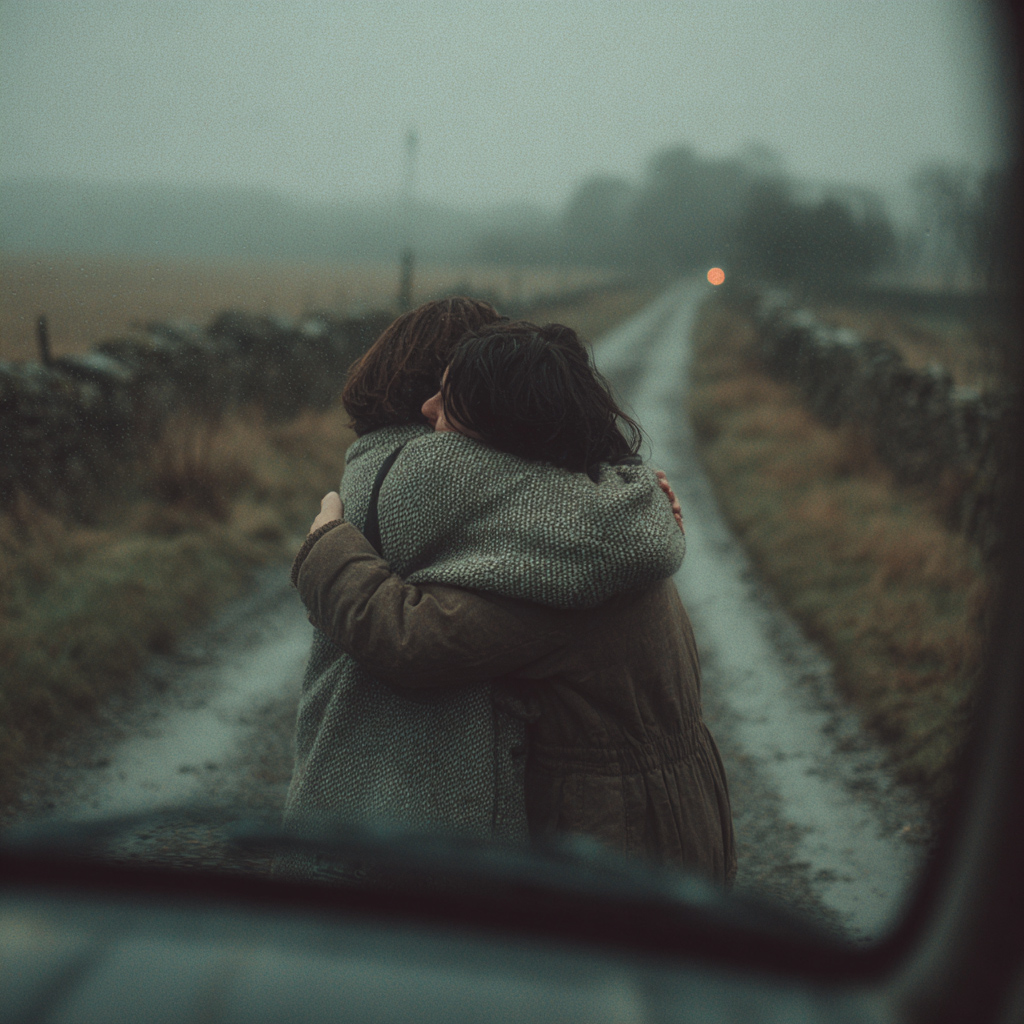
    “Do you need a hug?”
    she asked.

    And there we were—
    two strangers,
    just…
    holding on.

    Later,
    we both texted each other.

    Are you OK?
    we both asked.

    I apologised for my behaviour—
    though I guess
    I’m just tired

    of people reversing into me
    whilst I try to get on—

    with my life.


    Marginalia

    At the time of the first accident, I’d made a mistake on a client job. The client had been understanding, and so I tried to respond similarly to those who had reversed into me. But the bigger picture was harder to ignore: I was just trying to get on with my life, and other people’s dramas kept crashing into me—literally.

    There aren’t many whispers louder than a car crash, and I had two, exactly three weeks apart. It felt like the universe wasn’t so much sending messages as it was driving them straight into me.

    As part of a bigger story, both crashes happened just before I found out my herbal school was going ‘independent.’ By the time I unpacked that word, I was already in emotional gridlock.  You can read more about that in Dandelion Tears.