Tag: intuitive guidance

Dreams that offer clear direction, inner knowing, or a felt sense of what to do — not metaphor, but internal instruction.

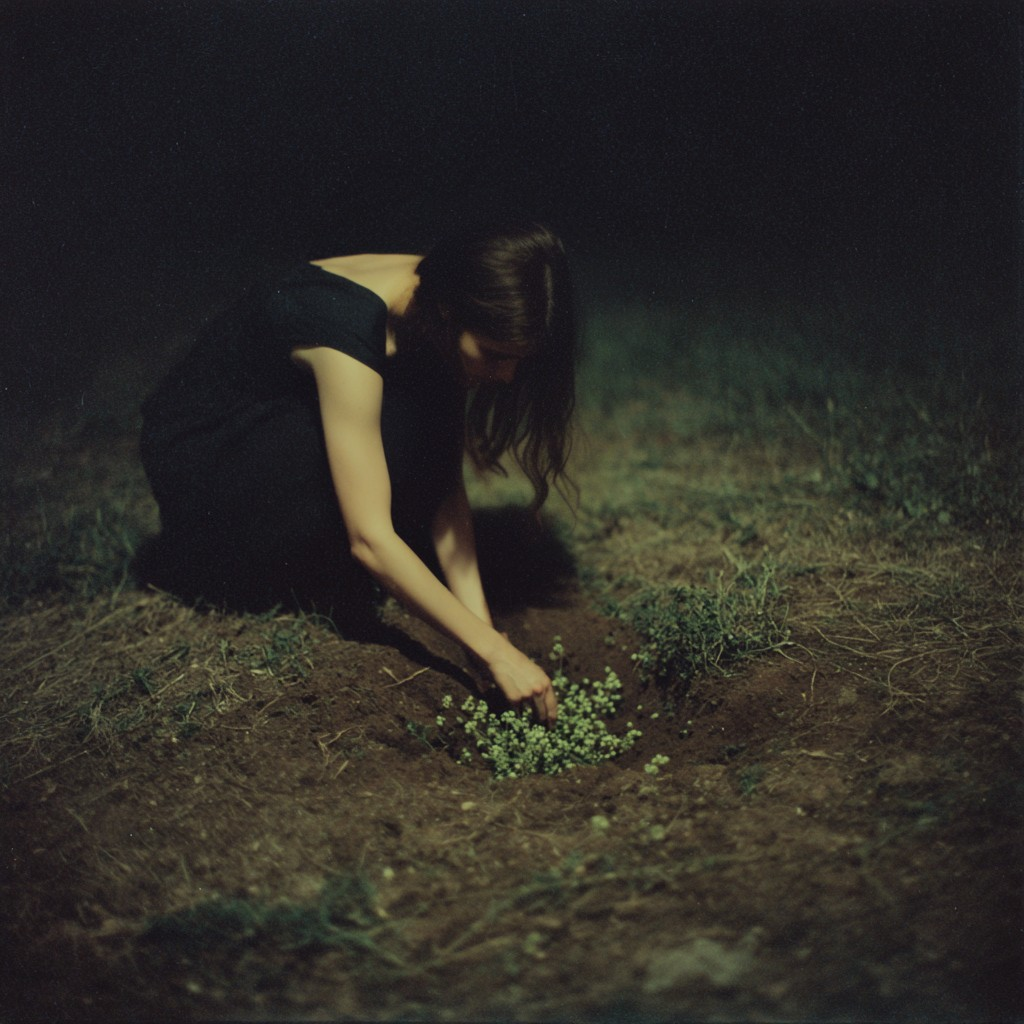
  • Sowing Meadowsweet

    Sowing Meadowsweet

    The Dream

    Darkness.
    Soil.
    Meadowsweet
    seeds.
    I scatter them
    lightly
    across
    the mound.

    A flowerbed
    prepared,
    or is this
    a fresh new
    grave?
    I never
    could
    tell.

    The Meaning

    sowing seeds
    The intention is growth—something new taking root.

    grave/flowerbed
    But the ground is uncertain.
    Am I planting into rich compost,
    or laying life into rot?

    What Lingers…

    What if growth and grief share the same soil—and the only difference is what’s acknowledged?

    What if the act of planting is enough, even if the ground only knows loss?


    Marginalia

    This is the second time I’ve dreamed of seeds and graves. In Poppy Seeds in a Rush of Yes, I was eager to buy seeds. In The Body in the Greenhouse, I drew attention to the secret buried in foundations meant for nourishment.

    Here, I’ don’t know’m unaware of what I’m planting into — but I seed with the intention that my efforts will bring a positive reward.

    Around this time, I’d gathered some wild Meadowsweet seeds but they never made it to my garden. Instead, they were forgotten in a pocket and sent through the wash. The powdery scent lingered on the clothes as I pulled them from the machine.

    I didn’t know until afterwards that Meadowsweet has been linked with burial rituals since the Bronze Age; its scent is believed to have helped mask the decay of the cadaver.

    But for the moment, it seems Meadowsweet isn’t mine to work with. I missed the blooms and lost the seeds but I trust she’ll return to me to when the time is right.

  • What My Natal Chart—and AI—Taught Me About Ancestral Healing

    What My Natal Chart—and AI—Taught Me About Ancestral Healing

    A story about panic, purpose, and the ancestors who whispered through the code.

    Dreams, Distractions, and Downloads

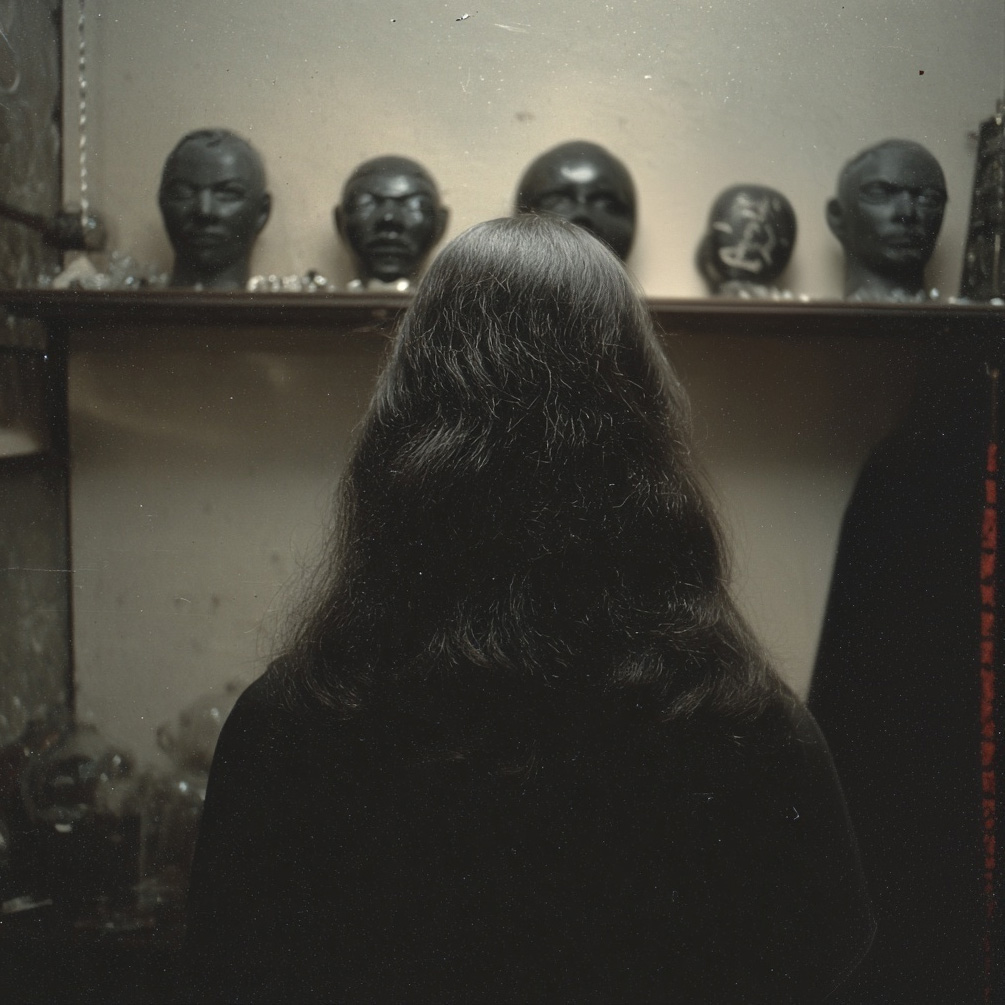
    I wasn’t exactly sure what made me do it, but recently my hunches had been striking gold—so I uploaded my natal chart into AI. A month earlier, I’d dreamed of four ebony heads on a shelf in The House That Contains Everything, which I knew instinctively represented four ancestors. In hope for some validation that I wasn’t losing it, I hit send.

    I never expected to uncover the names behind the heads.

    I was meant to be studying herbalism, but since my last school hadn’t worked out (I talk more about that journey in Dandelion Tears), I found myself in limbo, waiting to start my new course. The break would give me time to regroup and reflect on the last year, but instead of studying, I’d started following a trail of vivid dreams.

    At this point, I was wondering if I was just derailing my studies with unrelated side quests. And yet, I was compelled to journal what was happening: my dreams, the stories that were unfolding, the coincidences. Were these all unrelated experiences, or did they somehow tie into each other?

    Words, poems, stories, and dreams poured out of me—not in a “hey, I’m a literary genius” way, but in a “this feels like a fucking raw transmission from God knows where” kind of way.

    Explaining any of this to my partner felt weird. In fact, only one of my friends and my therapist could fully get on board. I felt baffled—perhaps low-key insane—but I was excited, too.

    How would these experiences affect my future as a practising herbalist if I started to share them publicly? Would friends start sidestepping away from me, or perhaps blink and change the subject? How would LinkedIn react? Would it ghost me even harder? Probably.

    Consulting the Machine

    I’d been using AI as a tool to help clean up my stories (let’s say I can waffle!) and had started to use it to brainstorm how all of this—whatever this was—might integrate into my herbal practice.

    When I first started herbalism, I felt it needed to have a spiritual aspect for me, but I didn’t want to alienate people with anything too woo.

    Now, I was exploring rabbit holes, thinking: How the hell do I get this to work without coming across as bat shit? AI is a sycophant, and whilst I didn’t want to bore—or scare the tits off—those close to me, I felt like I needed a second opinion.

    The idea came from nowhere. Perhaps I could upload the natal chart I’d done a while back? Maybe there might be something in there that might guide me? Make me feel clearer about this bread crumb trail I was following.

    I can’t recall exactly what I asked AI at first, but the reveals were exposing. Apparently, my chart is a lot. Like, all fire and no extinguisher kind of a lot.

    If you know me, you’ll know what that means. Let’s just say, I felt seen.

    I asked it if the work I was doing had any alignment with my karmic life path.

    Unequivocally yes.

    I nearly shit myself when it said that part of my journey is to undo all of the past ancestral trauma dumped onto my chart.

    Like… what? I felt intrigued. I had a big box in front of me, and I wanted to know more about what was inside.

    So I pumped AI for more.

    Four Ghosts and a Dream

    AI helped me identify four main archetypal ancestral ghosts who had set up shop in my psyche and brought all their baggage with them.

    Four.

    The same number as the ebony heads on a shelf that I’d dreamed about a month earlier.

    The heads I’d sensed were ancestors.

    My emotions were mixed. This was eerie, surprising, and a huge aha moment.

    Who were these ghosts? I pressed again, over various chats with AI. Finally, I identified them:

    The Matriarch
    The alpha woman who should have had control—but didn’t, despite being the smartest person in the room. She carried rage she couldn’t express.
    She’d wanted to lead.
    I inherited the rage she couldn’t express, and a desire to control.

    The Sad One
    The one who equated love with usefulness and cared too much while putting her own needs last. Feared being a burden. Felt unseen and unheard.
    She wanted to be heard.
    I inherited her need to be useful, to work hard, and to do everything perfectly.

    The Silent Male Shadow
    The ghost who is absent and silent. He represents an abuse of power or emotional distance. There’s repression and a distrust of authority.
    He wanted to be seen.
    I inherited panic every time I feel seen—and a distrust in authority.

    The Mystic
    The ancient one who bestowed gifts of intuition, dream-work, and symbolic thinking. She’s a presence in my chart, not a problem.
    She wants me to remember.
    I inherited—so it seems—a capacity to download from the unknown.

    Detective Work from the Beyond

    But who exactly were they?

    I was now desperate to find out.

    I suspected that my Great Uncle Jimmy was the Silent Male Shadow, and that my great grandmother Cleopatra was the Matriarch, but I had no idea who the other two were.

    I decided the best course of action was to seek out an actual astrologer who specialised in ancestry. I found the perfect match and eagerly awaited their reply. But when it came to booking, I was disheartened to find that this sensitive one-to-one service had an appointment service run like a ticket hotline.

    I felt the frustration flex inside me. I started writing an arsey email—and then stopped.

    This was not my lighthouse.

    My lone wolf instinct took over.

    At this point, I turned back to AI. I uploaded natal charts for all my maternal and paternal ancestors and asked it to match them to mine.

    I’d considered how these people might feel about a descendant of theirs digging about in their inner worlds—but I felt at peace with my decision to know them. I believe that everyone wants to be known and seen by one person at least. Even if that scares them. Only true connection can come from being vulnerable and open. And besides, these guys clearly had something to say or they wouldn’t have been so persistent.

    AI helped me identify them through both archetype and synastry, and to avoid hallucinations and errors, I repeated the process again and again until I was confident.

    Over the course of two weeks and many chats later, I finally placed the key ancestors in my chart:

    Emma Beckett, my great-great-great-grandmother (maternal-paternal line): The Matriarch

    Cleopatra Beckett, my great-great-grandmother (maternal-paternal line): The Sad One

    James “Jimmy” Carney, my great uncle (paternal line): The Silent Male Shadow

    Catherine Heffernan, my maternal great-grandmother: The Mystic

    The four ebony heads from my dream had actual names. Life. History.

    I’d picked apart my ancestors’ charts like an astral forensic detective. I got to know their personalities, how their charts interacted with those close to them. I started to understand their fears, their hopes, what they carried—what they never finished and what they’d passed on.

    Having found so much accuracy and truth in AI’s interpretation of both my chart and my living relatives’, I trusted it to breathe life into my dead relatives too.

    And regardless of people’s personal opinions on AI, I found it helpful to bring those I never got to meet into life.

    What This Taught Me

    This whole journey has taught me something simple: things shifted when I started to listen and trust my intuition.

    Whether what’s happening is a self-fulfilling prophecy or I’m just creating meaning from what was already there—it’s irrelevant to me. These people had deep stories they carried in their lives. Stories they never got to resolve. Stories they don’t want to be forgotten. They need to be validated, seen, and healed.

    Since my sister’s DNA test kicked off this whole ancestral journey (I recount this in It Began with a Name), I never expected it to go so deep. What started as a list of blank names to be dropped into a family tree has evolved into identifying actual souls who’ve entrusted me to heal life wounds they were unable to resolve. And that healing request hasn’t just come down the line—it’s come sideways, too.

    It’s made me consider how I want to be remembered, what legacy I’d like to leave behind. Do I want to continue a story of  trauma forward, or do I want to leave a legacy of healing? Even if I started off on the wrong foot, even if I can’t heal all the wounds I was entrusted with, even if I don’t finish the work—just naming it, bringing it to life, holding it up and saying… “Nah.” It’s a start. It’s enough.

    It’s made me look at my herbal practice from a much wider perspective—that physical symptoms aren’t just mechanical failures of the body with the occasional emotional root. Maybe they’re also spiritual residues—unknown to the person, but still quietly shaping their lived experience.

    And for myself?

    I never considered that my panic attacks might have something to do with my great-uncle Jimmy, internal rage be the culmination of so many stifled female voices, or that bouts of depression might not belong to me but the sadness of a life of service born by my great-great-grandmother Cleopatra.

    Now, I’m not so sure.

  • Ansuz, Laguz and Rahu

    Ansuz, Laguz and Rahu

    The Dream

    Camping.
    A muddy field,
    I lay out two picnic blankets.

    I watch—
    an immaculately dressed woman
    lays her blanket
    on the ground.

    I wonder:
    Will she get muddy?

    I turn around.
    My partner has rolled
    onto one of the blankets,
    stood up,
    ran backwards,
    and then forwards
    onto the other—
    he leaves a trail
    of footprints.

    I wake myself up,
    shouting at him.

    A girl sets up a stall.
    We’re at a public event.
    She’s young.
    I admire her bravery.

    I finger through her trinkets—
    children’s toys…
    I used to sell those
    in a past life.

    On a bus,
    I help a boy—
    he’d been injured.

    I’m also a child now.

    I recount how I’d fancied him
    for years—
    he’s never noticed me.

    My friend wants to speak
    with him and his friend,
    but I have no interest
    in chasing his affections now.

    When I finally wake,
    I have two symbols in my mind.

    I scribble them down
    and put the photo into OpenAI
    for it to find them:

    Ansuz and Rahu
    or in Western tradition,
    The North Node.

    But Ansuz has a third prong,
    which AI suggests is perhaps a bindrune.
    On its own, the other rune is Laguz.

    The Meaning

    muddy blankets
    I’m trying to create space in a mess.
    I wake, shouting.
    This is about space being violated.
    I’m protecting boundaries
    while others clumsily crash on.

    woman
    I wonder if she’ll get muddy—
    but really, I’m looking to her to find out:
    How does she stay clean?
    This is the part of me that wants
    to move through mess
    without absorbing it.

    girl
    I see my past self in her,
    but from a place of gentle recognition,
    not regret.
    She’s starting something
    I once survived.

    boy
    I’m helping someone who never saw me,
    who I used to long for.
    Now?
    I’m not chasing.
    I’ve grown past the need to be chosen.

    The Symbols

    Ansuz: inspiration, transmission, divine voice.
    Laguz: water, emotions, intuition, depth, flow.
    Rahu/North Node: soul’s destiny, karmic direction.

    Together? A holy triad.
    I’m being told—clearly, cosmically:
    Listen.

    This is not random.
    Your path, your emotions, your dreams—
    they are one system.

    Stop second-guessing.
    The messages are coming through.
    And they’re meant for you.

    What Lingers…

    What if messages aren’t metaphor,
    but a map—pointing to what’s already known deep down?

    What if growth isn’t about staying clean,
    but learning how to move through mud with meaning?


    Marginalia

    In waking life, I was trying to understand how my ancestral, dream, and herbal work connected. I didn’t have a clear map or plan—just a hunch, and then this dream, among others like The Room Behind the Wallpaper, and The House That Contains Everything, kept nudging me forward. However unusual it seemed, I went with it, trusting it would all make sense in time.

  • Fireweed | A Phoenix from the Ashes

    Fireweed | A Phoenix from the Ashes

    Chamaenerion angustifolium. 

    Familiarity breeds contempt. She’s always been there. Each year she becomes louder, more demanding, and each year, I shut her out. Pull her up and curse her under my breath. But when I tried to grow various herbs in pots and all I got was fireweed, I had to rethink her presence in my life.

    Having spent years in battle, I’d resigned myself to accepting her. She had spunk. And, given the consideration, her tendril-like leaves and fuchsia bonnet weren’t ugly. In fact, she was a damn sight better looking than bare earth.

    Our relationship started with me harvesting her from our garden. She wasn’t even in the back. No, she was cleverly colonising the borders and had even started to take a punt at the lawn.

    Slowly, deliberately, I firmly pulled at the base of her stems, until she gave up the fight and relaxed into my hands. She’s actually quite a shallow weed—much like Yarrow—easy to unearth if needed.

    Sitting at the garden table with the sun at my back, I slowly peeled away a leaf, inspecting it carefully on each side before placing it into a bowl. I continued in a rhythmic meditation until my bowl was full and I was left with a mound of naked stems.

    Was she happy now? I pondered.

    For two days I allowed the leaves to ferment before baking them in a low oven. Apparently, this would deepen the flavours.

    I cropped another fist of stems. This bunch would dry on the stem. So I can compare the taste, I thought.

    Honestly, I wasn’t impressed. The notes—too high. The taste—too astringent. I came, I smelt, I tasted, and I went. I felt no alignment with this weed. We remained strangers, even if now we were in acceptance of each other’s proximity.

    But by now, I know not to ignore my herbal allies when they call for me. And usually, I get a lot from them energetically—but this one… well, she didn’t say much, considering she was so bloody loud in every other way.

    Rosebay Willowherb (another of her common names, though I prefer fireweed) has virtues including demulcent, tonic, and astringent properties, with historical use in treating intestinal affections. Modern uses include treatment for seborrheic dermatitis and ulcerative colitis, among others.

    And there I wobbled my head and lol’d. Having been diagnosed with UC a few years back, and only recently with seborrheic dermatitis—after suffering for over twenty years—my head did a little high-five for ‘yay herbs’.

    And then I went back to ignoring her again.

    Every time I opened the door, a few more crusty leaves would drop to the floor. And I’d vacuum them up without a second thought—whilst scratching my ears… like I’ve done for years.

    When I know something is good or bad for me, sometimes, just knowing isn’t enough for me to change. I don’t know what it is inside that finally causes me to snap out of inertia and change behaviour.

    Often I wonder if it’s when something becomes so unbearable, or the downsides far outweigh the good. When the payoff to do different is rewarding enough.

    And it’s in self-reflection here that I started to wonder if I’d become married to my conditions. Why would I be holding onto these afflictions like a scabby old blanket? Did I think I was special? Or did I think, deep down, I didn’t deserve to be well?

    Or maybe fireweed just wasn’t tasty enough to endure on a daily basis—stripping the enamel off my teeth with every sip.

    A few weeks later I dreamed… guess who?
    Yeah, there she was, on my ‘to-do’ list like a herbal calling card.

    Fireweed was now basically saying: For fuck’s sake, Lee. I colonised your garden, your seed trays, and now your dreams, you daft bitch. Sort yourself out!

    That morning, I made myself a cup of fireweed tea.
    Okay okay, I said. I’m listening.

    And I gave her the space she’d been demanding from me. I sat down as I do, glass cup in hand, and we walked.

    Nothing dark.
    All the high notes:
    Lemon.
    Astringent.
    Drying.
    Bitter.
    Floral.
    Green apple.
    Fruit… cherry?
    Drying my teeth.
    Squeak squeak.

    Why aren’t we vibing? I thought.

    Never mind we don’t vibe.
    Drink your medicine.

    Fireweed wasn’t here to vibe.
    She was here as the medicine I so obviously needed but was reluctant to accept. And she, just like me wasn’t about to give up on her opinion that she was right and I should get my big girl pants on and do the work instead of nodding in agreement only half convinced about the way forward.

    Sometimes you don’t have to be convinced of the way, you just have to take the information you have on hand and make a judgment call based on facts, not feelings.

    The path might be boring and uneventful but necessary nevertheless.

    Bottoms up.

  • Fireweed and Bunny Munro

    Fireweed and Bunny Munro

    The Dream

    Herb school.
    I was struggling to learn.

    My teacher asked me:
    “Do you know the route of Bunny Munro?
    The low road along the river?
    The one he took to go fishing?”

    I nodded, uncertainly.

    “Then you know where I live.
    Come round at 7:00,
    and I’ll take you through it.
    A list.
    Of things to do.”

    Fireweed.

    It’s the only entry I can recall.

    The Meaning

    school
    The new path forward.
    But I’m struggling.
    And I need help.

    teacher
    She’s willing to guide me—
    but she expects me to take the path Bunny didn’t take.

    river
    The emotional low road.
    Inward.
    Following the bank of my inner landscape.

    The river = emotion.
    Fishing = delving.
    Go deep. Go slow.

    7
    The number of the divine.
    A cosmic nudge:
    Take the hard, boring, muddy path through your emotions.
    Fish out what’s true.
    Show up at my place at 7—and everything will become clear.

    fireweed
    She grows from ashes. We’re going to need her.

    What Lingers…

    What if the path to healing runs low, not high— through mud, not sky?

    What if blooming from ashes isn’t a miracle, but a method Fireweed already knows and can teach?


    Marginalia

    I’m waiting to begin a new herbal medicine course, and my dreams are pulling old patterns and fears to the surface. This is the second in a series of herb school dreams.

    In Incense Blocks & Period Costumes, I weigh old ways against new.
    In Competence vs. Compassion, I’m profiled by my tutors.
    In I Was Late, Afterall, I abandon my own needs for accountability.
    In Flawed but Trying, I’m exposed in my mess while defending my son.

    Journaling helps to see the tapestry being woven: the curriculum beneath my surface, the lessons I didn’t know I was studying.

  • The Room Behind the Wallpaper

    The Room Behind the Wallpaper

    The Dream

    An old house—
    it was damp.

    Around the windows,
    the walls
    were soaking wet.

    Beneath the fabric wallpaper,
    I discovered
    a hidden room.

    Inside
    a writing desk—

    it was warm
    in there.

    Really warm.

    I suggested
    we should open it up
    to the rest of the house—

    let the heat
    out.

    The Meaning

    the damp house
    My psyche. It’s not unsafe, just a bit neglected.

    the windows
    Where light and truth should come in. But instead? Wet. Seeping.
    I’m checking the perimeters. Looking for where my boundaries let the weather in.

    the hidden room
    peel back the wallpaper and find… A space I forgot I had.
    A room with purpose, solitude, warmth.
    A creative core.
    An inner writer.
    A part that doesn’t need fixing—it just needs revealing.

    the warmth
    This is the warmth of readiness, presence, creative potential. I’m not discovering anything bad—I’m discovering a solution.

    letting the heat out
    I’m finally ready to say, let this part of me affect the rest. Let this warmth inform the cold spaces. Let this creative core change the larger structure.

    What Lingers…

    What if the solution isn’t on the outside, but already glowing deep within?

    What if the warmth that’s been hidden is finally ready to lead?


    Marginalia

    By this time, events and dreams we’re coming thick and fast. I didn’t know why, exactly—but I felt clear: I needed to record everything. This dream felt like a nudge in that direction, opening a warm part of me I didn’t know was there.

  • Poppy Seeds in a Rush of Yes

    Poppy Seeds in a Rush of Yes

    The Dream

    I dropped everything
    I went
    to the garden centre
    I bought poppy seeds.

    I was
    so excited.

    The Meaning

    dropping everything
    Freedom. Urgency. Joy taking precedence.

    the garden centre
    The source of potential. A sanctum place of future beauty.

    poppy seeds
    Poppies symbolise: Sleep and dreams, remembrance (grief, history, ancestors), wild beauty and literal psychoactive transformation. I’m not planting daisies. I’m planting something deep, something ancient. And I’m thrilled at the idea of cultivating something that could change me.

    What Lingers…

    What if joy doesn’t need justification to be sacred?

    What if the deepest transformations begin with the tiniest seeds—planted in a rush of yes?


    Marginalia

    I’d written the story of my ancestry research: It Began with a Name. This is the dream I was rewarded with. Clearly, the ancestors are delighted with the progress I’ve made. There is celebration and the joy of planting something new, so unlike the heaviness of The Body in the Greenhouse.

    In waking life, I did go and buy poppy seeds. It seemed only fitting to add some to my herb garden. I didn’t press them neatly into the soil—I just threw them across the bed. Now I’ll wait, and see what rises next season.

  • It Began with a Name

    It Began with a Name

    Cleopatra, Vaz, Massias

    It began with a name.

    In 1829, a Jamaican woman called Elizabeth Thomas Massias wrote her son into the world with all the power she had—a surname.

    She had no legal patronage, no husband, no inheritance, and no voice in the colonial record beyond the tight cursive handwriting that marked her as “unmarried.”

    But she took the name Massias anyway, claiming it from a man who never signed his name to her fatherhood, weaving into her son’s future—the only thread of protection she could offer him.

    This name, and the quiet naming of his father, gave her son a legacy that could open doors, that could make more of him than she could ever provide.

    She gave him lineage in a world built to deny hers.


    A century later, across the Atlantic in Liverpool, another woman—my Nana—made the opposite choice.

    She omitted the name of her child’s father, keeping it a secret through war, marriage, and motherhood.

    My mother’s lineage—half-hidden—was buried with my Nana’s silence.

    Not because my mother didn’t matter to her, but because she did.

    And in a world of shame and racism, silence and the olive skin of her daughter were the only armour she had.

    From the woman who lived in my inbox for twenty years to the dreams that led my search, this is the story of what’s been lost and found between those two decisions.

    It’s about the women who protected their children.

    It’s about the names we carry, the ones we bury, and the ones that claw their way back into the light through threads we’ll never understand.

    This is our story.


    Jamaica, 1829.

    At the registry office in St Catherine, a woman gives the clerk her name—all of it: Elizabeth Thomas  Massias.

    That extra surname, Massias, doesn’t appear by accident. It’s a signpost slipped into history, pointing to a lineage she carried but would never be officially recognised for.

    Elizabeth was most likely born a free brown woman, thanks to a father who wouldn’t claim her, but whose social standing provided just enough protection to keep her outside the grip of slavery.

    Standing within a system designed to deny women like her any real power, she makes her move.

    When it comes time to name her son, she doesn’t settle. She adds another significant name to the record—his father’s: Vaz.

    In that moment, Elizabeth does what the system won’t. She connects the boy to both men.

    This isn’t just a registration. It’s an act of security.


    I suspect both men were of high standing.

    That was often the currency that gave them unchecked access to the bodies of young Black and brown women.

    Elizabeth—like her mother before her—would have worked in close proximity to such men, perhaps as a housemaid, needleworker, or washerwoman.

    Her mother, unnamed in any record, most likely lived as a slave.

    Elizabeth and Horatio are the first figures to emerge from the fog of my maternal ancestry, names pulled from scanned pages and fading ink.

    It took me nearly half a century to find them.


    Nearly one hundred years after Elizabeth registered her child’s birth, my sister received a DNA kit as a Christmas gift.

    She’s always been drawn to our family’s origins—it was once a weekend ritual with our father, hours spent squinting at microfilm in the city library.

    But that was a lifetime ago. The trail had gone cold. Life, as it does, had taken over.

    She swabbed her cheek and sent off the little box—filled with possibility—to the lab. Then she waited.

    Weeks later, my phone lit up with a single, cryptic message: “You’re not going to believe this.”

    Attached was a screenshot: a colourful ancestry wheel crowded with percentages and country names.


    What am I looking at? I texted back, impatient.

    “It’s my DNA. Look—it says I’m mixed race. It’s on Mum’s side. Mum is mixed race!”


    I was puzzled for a moment, but then the old cogs began to turn.

    We’d always laughed at photos of Mum as a child. Everyone laughs at old family photos, right?

    But we’d fixated on one particular feature: her hair.

    As a child, she had the most stunning corkscrew curls. Yet by the time her younger siblings came along, the curls were gone—cut away, replaced by what we could only describe clumsily as a “white afro.”

    The contrast was stark, especially next to her siblings’ neat, poker-straight bowl cuts, their faces distinctly like their fathers’: Mum’s not.

    Those two photos are still hanging on the sitting-room wall.

    The truth in plain sight.


    “Does Mum know?” was the first thing I asked.

    Turns out, she did.

    She casually shared how the man she came to call Dad had bought her a bicycle as a child and how she’d never asked her mother about her paternity in case it hurt her mother’s feelings.

    Somehow, I suspect she expected no enlightened response.

    It wasn’t customary to dwell on the past.

    My nan had been married previously; my mother was a product of that short union.

    Had he died, or had they divorced?

    My mind went wild.

    Who was this guy?

    And why were we never told about him?

    The search for my missing grandfather and Nan’s first husband began.
    I obtained a copy of Mum’s birth certificate.

    The name was the same as her mother’s maiden name: Foster.
    I traced him through records, found people, and reached out; all the while our African and Portuguese heritage remained a mystery.


    My sister took to chasing her DNA strands around the USA, the literal fragments of her identity scattered across the earth.

    Me? I decided to have my own DNA tested.

    Maybe my sister’s had been mixed in the lab.
    Maybe she wasn’t my sister.
    Maybe we’d find out more about who we were.

    I decided to use a different company this time, again popping my DNA in the postbox to be filed, matched—and possibly used for nefarious gains in the future.

    I didn’t care. I just wanted to see if my sister was the family oddball.
    She’d always said she was convinced she’d been adopted; now this was her chance to break free of us.

    Unfortunately for her, the results confirmed not so.


    While my sister’s test had got the ball rolling, mine provided a lead.

    “Oh my God! We’ve got an Auntie and cousins in Liverpool!”

    By now, my younger brother, had started to lean in on the action.
    Where my sister and I were driven by the story, my brother was driven by his face.

    Whose face did his echo?

    Because, truth be told, my brother looked more like Mum than we ever did, and he certainly shared no features with any of our cousins either.

    So it was him who took the lead in reaching out to our potential long-lost aunt.


    I can’t really describe how it feels to intrude into someone’s life who you should’ve known all along.
    The message was awkward, meek, and unsure.

    Though when my brother hit send, this total stranger came back and confirmed our connection like she’d been waiting for it—and, to some degree, was expecting more.


    We didn’t know what to expect.
    But what we found was more than we hoped.

    She was warm, welcoming, and generous with her knowledge.

    Her father’s name was Aston Vaz.
    The same name my Nan had taken to her grave—our grandfather.


    As my aunt explained, she’d always known about my Mum but had been told Mum had emigrated to Australia.

    And there wasn’t just her either.

    In conversations with her, we learned of a whole family of aunts and uncles in Liverpool and around the world.

    It was apparent—and sad—that these relatives had known about each other, and yet we’d been kept in the shadows of their lives.

    Secrets made of our blood.


    But this was to be expected.

    Nan had been married for just four months at the time of my mother’s conception and had likely just sent her husband off to war, possibly a man she’d never see again.

    My Grandad, on the other hand, had made his passage from Jamaica to the UK on a banana boat bringing supplies to the country, and Nan had fallen for his charms—or perhaps he’d fallen for hers?

    We’ll never know.
    I won’t pretend to understand what war does to people.

    But when every moment might be your last, who can blame anyone for grabbing hold of something that makes them feel alive?

    Unfortunately for my Nan, her chance of living in the moment would be etched into her life forever—through the very existence of my Mum.


    When my brother asked her if she had a photo of Aston, she said yes—and he was elated.

    Finally, a chance to trace his unfamiliar features back to their source.

    My aunt’s email explained: you could always spot a ‘Vaz’ by their distinctive features.

    And when he opened the attachment, he too knew what she meant.

    He was looking into a mirror—the eyes, the nose, the chin. Distinctive family traits.

    He showed us the picture.
    We gasped.


    I wondered how Nan had felt, watching my brother grow up with a face that mirrored the man she never named.

    I wondered if it made her feel discomfort, fondness, shame, or regret—perhaps all.


    Meanwhile, my aunt was excited at the prospect of being reunited with her sister—especially now, as the sisters she knew had started to pass away.

    She eagerly asked him to pass on her message:
    she would really like to connect.


    But when we broke the latest news to Mum, she grew cold.
    Distant. Sharp.

    “He is nothing to me.
    That is not my family.
    My father is the man I called Dad, and my family are those I know.”

    She made it explicitly clear: she wanted nothing to do with these people.
    She shut the conversation down completely.

    There was no interest in seeing her biological father’s face, no curiosity left to explore.
    The cupboard of skeletons, slammed shut.

    “He was nothing but a sperm donor.”


    Her pain seared through me and my siblings.

    We couldn’t understand its origins exactly, but pressing further felt like trespassing.

    We didn’t know if she had ever suspected her racial background—or if she had always known, and simply chosen not to face it.

    Whatever the truth, it was too painful, too uncomfortable, and, at over seventy, something she was unwilling to confront.

    So, just as she had foregone her own curiosity about her mother,
    we felt we had to do the same.

    To be silent once more.

    We left the conversation alone—for a while.

    Then one day, my sister raised it again.

    “Someone I once worked with asked me if I was a Vaz,”
    Mum said.

    But when my sister followed up, she was shut down again.
    Quickly. Firmly. End of conversation.


    By now, my brother’s curiosity had been satisfied.
    He knew who he was.
    He knew where his face had come from.

    Mine, however, remained unanswered.


    Grandad Aston was Jamaican—and I knew, somewhere down that line,
    it would lead to slavery.

    I felt apprehensive.
    But I couldn’t not try to understand.

    So I started my search.


    That’s when I found her: Aston’s mother.
    Her name stopped me cold—Cleopatra Elisabeth Beckett.

    Cleopatra had been the name of my first cat—and, by extension, my first email address: cleo21.

    A coincidence? Maybe.
    But it felt like something more.

    A whisper from the past.
    A presence brushing against my life before I ever knew who she was.


    As a child, I was fascinated by the Egyptian queen—not just for her beauty, but for her power.
    It felt rare to see a woman admired for how she looked and still remembered for how she ruled.

    Even then, I understood that kind of power—subtle, strategic, often silent—was sometimes all a woman had.
    And sometimes, it was all she needed.


    My great-grandmother’s name was no mistake.

    Her mother, Emma, hadn’t just given her the name of one great queen—but two.

    A gesture of hope.
    A kind of elevation from her own humble working-class life.

    What mother doesn’t wish the best for her child?


    But in the late 1800s, ambition had its ceiling—especially for a young Black woman.
    Names could only take you so far.


    When I uncovered Cleopatra Beckett’s early life, I recoiled.

    She had ten children over her ninety years.

    The first, a daughter named Myrtle, was born when Cleopatra was just sixteen.
    The father, Charles Alfred Vaz, was forty-eight: a doctor, well-established.

    Already a father of twelve with another woman.
    And now, apparently, beginning a new lineage with my great-grandmother.


    By the time Cleopatra boarded a ship to New York—a year before Charles’s death—she had borne him five children.

    I kept wondering:
    Did she see Charles as a path to stability?
    Was she coerced? Exploited? Loved?

    Did she choose this life—or simply survive it?

    The truth is likely twisted in all these directions—
    a knot of powerlessness, resistance, and the kind of quiet calculation
    only a young Black girl with almost no options could be forced to make.


    Even that journey to New York was not straightforward.

    She was detained at Ellis Island for two days.

    The official reason?

    She was labelled “immoral.”


    Immoral…
    I read that word in the scripted log—it landed hard.

    It wasn’t the forty-eight-year-old man who, by modern standards, had groomed a child who was immoral.
    Nor the colonies, which had failed to raise the age of consent to sixteen, as the UK had done back in 1885.

    No.

    The burden of society’s moral standards fell squarely
    onto the lap of a thirty-year-old woman travelling abroad to see her sister.


    For two days, she was detained.

    Was she scared?
    Was she tired of the double standards—
    or did she take it all in her stride,
    without even a side-eye?


    I tried to trace Cleo’s ancestry, but hit a dead end.

    Births weren’t officially recorded before 1878,
    and records were sparse for Black or mixed-race families—
    especially those born out of wedlock.

    And truthfully, I had no desire to trace the man who’d fathered her.

    I slammed my laptop shut.
    I didn’t have the stomach for more.


    Years passed before I picked up the trail again.

    I found myself thinking about Cleopatra again.

    First, I dreamed of her—felt her presence, acknowledged it.

    Then came another dream: four ebony heads sitting on a shelf, their eyes closed.

    When I woke, I knew—
    I wasn’t done.

    There was more to know.
    More to understand.

    Like fog beginning to lift, the facts started coming quickly.

    I found Cleopatra referenced in a book.
    The author detailed her Ellis Island questioning:

    “…unmarried, is supported by a colored [sic] doctor by whom she has four children, the oldest of which is 13 years old.”

    I froze.

    Colored?
    I had assumed Charles Vaz would be white, given his Portuguese heritage.
    But now, I wasn’t sure.

    I leaned in.
    I contacted the author.

    To my shock, she responded immediately—kindly, generously.

    Cleopatra had been travelling for a medical operation, and yes, the record was correct:
    Charles was ‘coloured.’


    I searched more.
    His partner had been alive in Panama the entire time he was with Cleopatra in Jamaica.

    Did these women know about each other?

    A year after Cleopatra travelled to New York, Charles married that partner—
    just months before his death.

    One woman was invited to secure her name.
    The other was left behind.


    How did Cleopatra feel?

    Did he arrange support for her and their children?

    The youngest—my grandfather—was just nine.

    Or were they all left behind, written out of his ending?

    Did the children ever get to say goodbye?


    A knot of emotion rose in me—
    questions tangled with sadness.

    This didn’t feel like a happy ending.


    By now, I’d decided to trace this man who had fathered seventeen children in sixty-three years.
    How could he afford it?

    As a ‘coloured’ doctor, Charles had done remarkably well—
    he’d earned medals from the UK Navy for his service.

    His father, Horatio, had lived a more modest life—
    only two children with a wife of Scottish descent.

    But he’d passed down a name and the legal standing that gave Charles his head start.


    Like many, I turned to OpenAI and asked if Horatio’s job as a clerk
    was common for children of the formerly enslaved.

    Slavery ended in 1834.
    Horatio would’ve been five.


    The model’s response left my jaw slack.

    Horatio’s life wasn’t typical—it was exceptional.

    He wasn’t just any clerk;
    he’d been the crier of the Supreme Court and the Kingston circuit court.


    I’d assumed Charles embodied white privilege.

    But now, I was watching how Black and brown Jamaicans navigated—
    sometimes even flourished—within colonial power structures.


    Horatio had stepped into the middle class.

    As a respected member of the Masonic lodge,
    he was entrusted with caring for a young Black orphan, Augustus Williams.

    I even found a letter Horatio wrote to Barnardo’s in London,
    vouching for the boy’s character.


    And Horatio’s mother?

    When I finally found her, I found another woman, silenced and left behind.
    Another mother desperate to give her child what she never had.

    Elizabeth Thomas Massias—a ghost in the records—
    had gifted her son a double-barrelled name stitched with whispers:
    Massias. Vaz.


    The names Massias and Vaz are deeply rooted in the Sephardic Jewish community
    that arrived in Jamaica from Portugal during the Inquisition.

    They had, by then, intertwined with the local Black population
    through generations of marriages and births.

    Though there are no official records of confirmation,
    the names in the area around that time suggest Massias was a proprietor
    and the Vaz family was respected within the Masonic community.


    This wasn’t the machinery of dominant white colonialism.
    This was how the marginalised navigated, subverted, and reshaped cultural practices
    to carve out space where none was offered.


    In another quiet rejection of his paternity,
    George Horatio Vaz wasn’t registered in the synagogue—as his name might suggest—
    but in the church.

    Another inch towards plausible deniability.
    Another sidestep around a father’s name.


    These Sephardic Jewish names weren’t outside the system.
    They were part of it.


    Elizabeth’s father had standing, just enough to grant her some protection.

    But she was still insignificant.

    Just like Cleopatra, born to a Jamaican labourer.
    Just like my Nana—diminished by the systems that gave men power and handed women responsibility.


    The stories of these women—
    and the children they fiercely protected—
    show us something else too:

    Race, class, and patriarchy are a soup none of us escape.
  • Valerian | Descent with the Morrígan

    Valerian | Descent with the Morrígan

    Valerian showed up in shadows—
    of sleepless nights, dark woods,
    and quiet omens.

    She shapeshifts—
    like her effects:
    soothing one dreamer; haunting the next.

    This is how she arrived—
    not with clarity,
    but dripping in contradiction.

    I tried to choose her.
    She doesn’t explain.
    But I kept showing up.
    And then, so did she.

    Valerian is not for comfort.
    She’ll take your hand,
    walk you to the edge—
    and show you the dark sea
    beyond your waking mind’s eye.

    If it suits.

    This is the story of that descent—
    and what I found, where she led me.

    Perhaps you’ve met her too?

    The First Descent

    I was desperate to sleep.
    I tried magnesium, sleep hygiene,
    all the usual rituals.

    Then I tried her.

    She didn’t soothe—
    she stalked.
    Her scent was feral.
    Fermented.
    Strangely beguiling.

    She unfolded herself
    in layers of ambivalence.

    I learned this the hard way—
    through the morning hangover
    she gave me
    when I didn’t respect
    her nocturnal virtues.

    That was my first lesson—
    she demands reverence,
    not assumption.

    Meeting the Morrígan

    By the time of tea tasting,
    I recognised her.

    With my eyes closed.
    Mind open.
    Tea warming my hands.

    She arrived:

    It’s time to hunker down,
    by the fireside.

    With rose petals and decay.
    A wood hut.
    Mulched leaves.
    There’s dankness in the air.

    Apple pie
    and custard,
    laced with toasted almonds
    and spice.

    This is autumn—
    Samhain.

    A pregnant, liminal space.
    A bountiful harvest—
    followed by
    the horse-drawn carriage of death.

    To me, Valerian is the Morrígan—
    not because she told me,
    but because of how I felt her:

    Cloaked, paradoxical,
    full of omen.

    A crow in the shadows.
    A whisper at the edge of sleep.
    The one who lifts the veil
    between this world
    and the next.

    A predictor of futures,
    an agent of death.
    She lights the lamp.
    Opens the gate.
    She is fate.

    The Trickster Herb

    My herbal apprenticeship required
    two immersions on the Isle of Arran.

    Each time, we were asked
    to walk with a herb in flower.

    During my first trip, I chose Dandelion.
    But Valerian’s leaves were spotted—
    always in the shadows,
    on thresholds,
    waiting.

    She’s not like her namesake sisters,
    you know,
    the showy red and ashy blonde
    that root into stone,
    waving from the roadside…
    “Cooie!!!”

    No.
    Valerie is aloof.

    On my second trip—
    I chose her.

    But again, only her leaves appeared.

    Why was I chasing her?
    I can’t be certain.
    Isn’t it nature to want
    what we don’t have?

    Instead Yarrow took my hand.
    And Valerian stalked
    as a hooded crow—
    watching from the edges of the shore.

    Oil & Omen

    Yarrow and Valerian were intertwined by now.
    So on my return, I ordered both as oil.

    Valerian’s scent made me queasy.
    I shelved the idea.

    Maybe she wasn’t mine after all.

    A year on, Yarrow had barged into my life.
    And still—no sign of Valerian in bloom.

    That summer, admiring my parents’ garden,
    a magpie landed on the grass.

    Then another—
    demanding, loud, open-beaked.

    Its mother fed it.
    I’d never seen that before.

    And I knew.
    A message had arrived.

    The Scent, The Descent

    Back home, I opened my plant ID app.
    The notification bell was alight.

    A confirmation of an observation:

    Valeriana officinalis.

    I was bemused.
    How could I have been obsessing over this herb—
    taken a photo of her—
    and not even realised?

    But I had.

    I had an idea.
    I added two drops of Yarrow
    and one drop of Valerian oil
    to my burner.

    I breathed deeply—
    because you can’t quite make out
    what you’re sensing.

    Naturally,
    you take your time.

    Each breath:
    deeper, slower, more deliberate.

    Each one,
    a step down
    into the basement of my dreamland home—
    the staircase which leads directly
    down onto the seashore.

    At high tide, the last few steps:
    beneath the surface.

    But today,
    I hear children playing.
    The tide is low
    and the weather is stunning.

    I’m descending now,
    a single rope around my waist.

    Yarrow—provides Valerian with a boundary.
    Yarrow catches the gate open with her foot.
    So the descent can be made—
    with a safe route back.

    The Message

    The next day,
    my son had found a small bird—
    not moving.

    He’d nurtured it to recovery
    until it flew away.

    He set up his camera in the garden.
    He wanted to see if it returned.

    The next day, he came in.
    “Look what I captured on my cam, Mum…”

    Ah yes, I thought quietly.
    Magpies.

    Valerian was ready—
    to feed me.

    Valerian and Yarrow journeyed me
    to meet my sleeping ancestors.

    The message?
    Seek their eyes.

    They’ve been waiting
    for yours.

  • The House That Contains Everything

    The House That Contains Everything

    The Dream

    Eating food
    with a friend I volunteer with—

    the meal was amazing,
    complex,
    tasty.

    I needed to go shopping.

    Instead I
    showed my partner
    around the house
    we were living in.

    I’d finally decided
    I could face
    the huge task
    of renovating it—

    it was fucking massive.

    I’d already explored
    the newer parts—
    carpets, beds,
    salvageable things
    from the previous owner.

    I said it was all easy enough—
    except the freezing cold room
    next to the front door.

    It had bars
    on the inside.

    It felt haunted.

    We toured the old wing—
    cold rooms,
    ancient furniture.

    He pointed
    to a sloping wall.
    “Subsidence,” he said.

    I wanted to reuse
    the furniture.
    He wasn’t keen.

    The rooms were filled
    with character,
    creepy in places—

    four ebony heads,
    their eyes closed
    sat on one shelf.

    Black magician capes
    with crystal balls at the collar,
    displayed on mannequins.

    Shelves
    of black stone balls
    with white inscriptions.

    Sheds
    connected to bedrooms,
    stuffed with bikes
    and bits of metal.

    I met a friend
    celebrating their graduation,
    wondering whether
    to tell social media.

    I encouraged her.

    My partner
    chatted—
    with a woman concerned
    about her son
    working illegally.

    I said, flippantly,
    “It’s hard—
    but it’s time
    to let him go.”

    To my partner
    I said
    we’d need to sort the bathroom—
    tiny.

    He wanted
    to rent the old wing out.

    I wanted
    to keep parts of it—
    even if the stuff wasn’t mine,
    I liked their character.

    Then,
    I entered
    the new wing—

    rooms connected
    by ladders
    and slides,

    rooms linking into others
    in strange ways.

    The décor was simple—
    but the structure,

    it was wild.

    The Meaning

    the meal
    Connection. Nourishment. Shared appreciation for something complex.

    the house
    My entire psyche—and here? It’s sprawling. Too big to casually renovate.
    I’m living inside my own complexity, and for the first time, saying, yeah, I can handle this.

    partner as witness
    He’s not the fixer, I am.
    He observes, comments, critiques, offers strategies
    but I’m the one touring him.
    He sees flaws. I see potential.

    room with bars
    The reception room by the front door. Freezing cold and determined to keep everything in. The trauma vault.
    It’s cold, defensive, possibly haunted.
    And whilst it’s not fixed, it is acknowledged.

    the old wing
    Memory. Inheritance. My ancestral/psycho-spiritual archive.
    These are my dormant powers, forgotten stories, and unclaimed emotional objects.I want to keep them because they carry depth.

    bike rooms
    Junk drawers of the psyche. Unsorted, but not useless.

    slides, ladders.
    The newest part of myself. Not polished, but playful. This part is
    more connected, more dynamic and nonlinear.

    graduation
    Someone’s ready to share what they’ve accomplished and I encourage them
    I’m helping others to celebrate themselves.

    renting out the old wing
    I’m saying not everything needs to be useful. Some things are just part of who I am.

    What Lingers…

    What if shadow work isn’t about fixing, but finally deciding to live in every room?

    What if some things don’t need to be cleared out, just honoured as part of the architecture?


    Marginalia

    This dream holds more than I’ve even begun to unpack yet—but it was the catalyst.

    When I woke, I knew: those four heads were connected to my ancestors. I felt it in my gut. This was the moment I knew I needed to pick up my ancestral research again. Research that led me to finding out who those four heads belonged to.

    But it wasn’t until I shared the dream with a friend that something clicked. The room at the front of the house was Jimmy’s.

    Working more intuitively, I’ve learned to trust that kind of knowing. Without it, I wouldn’t have gotten this far.

    And the more I trust, the more I find is revealed.